Flower Agate: Meaning, Healing Properties & How to Use It
Flower Agate: Meaning, Healing Properties, and How to Use It
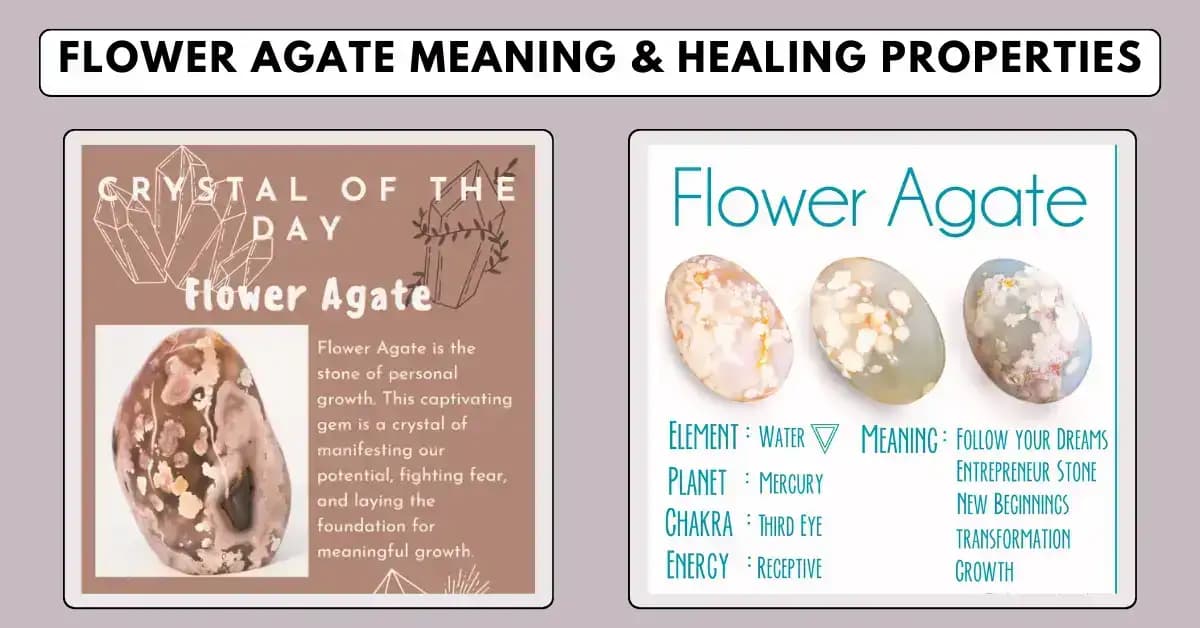
Flower agate is a pink-and-white chalcedony from Madagascar, covered in pale plume-shaped inclusions that look like flowers scattered through fog. It appeared on the mineral market around 2018 and became one of the fastest-selling new stones of the past decade, largely on looks alone.
This guide covers what the stone actually is, where the patterns come from, what people use it for in crystal practice, and the practical things worth knowing before you buy how to spot dyed material, what it costs, and how to care for it.
What Flower Agate Actually Is?
Flower agate is a variety of chalcedony, a microcrystalline form of quartz with the chemical formula SiO₂. Chalcedony is quartz built from crystals too small to see individually, which gives it a waxy, slightly translucent look rather than the glassy transparency of a quartz point.
Property | Detail |
Mineral family | Chalcedony (microcrystalline quartz) |
Composition | Silicon dioxide, SiO₂ |
Mohs hardness | 6.5–7 |
Crystal system | Trigonal |
Luster | Waxy to vitreous |
Transparency | Translucent to opaque |
Primary source | Madagascar |
Typical colors | Pink, peach, cream, grey, white |
At 6.5–7 on the Mohs scale, flower agate is hard enough for rings and bracelets that get daily wear. It sits just above window glass and just below topaz. It will scratch if you drag it across granite or store it loose with harder stones, but it holds up to ordinary handling without much fuss.
It is a trade name, not a mineralogical one
"Flower agate" is a commercial name, not a term you will find in older mineralogy literature. The material was introduced to the market around 2018–2019 and named for its appearance. You will see the same or very similar Madagascan material sold as cherry blossom agate, sakura agate, and blossom agate these are largely marketing variations rather than distinct stones.
This matters when you shop. Two sellers can list identical material under different names at different prices, and neither is lying.
Where flower agate comes from?
Commercial flower agate is mined in Madagascar, with material coming primarily out of the western part of the island. Madagascar is the dominant and, for practical purposes, effectively the only significant source of the pink-and-cream material sold under this name.
If a listing claims Brazilian or Indian flower agate, it is probably either a different stone entirely or Madagascan material with an inaccurate origin label.
How Flower Agate Forms?
The "flowers" are the interesting part, and most articles skip the explanation.
Like other agates, flower agate forms when silica-rich fluids move through cavities in volcanic rock and deposit layer by layer over long geological timescales. In ordinary banded agate, this produces the concentric stripes everyone recognizes.
Flower agate does something different. Instead of depositing in even bands, chalcedony crystallized radially outward from individual nucleation points scattered through the matrix tiny seed sites where crystal growth began. Each of those seeds grew into a spherical or plume-shaped cluster of fibrous chalcedony, spreading outward like a firework frozen mid-burst.
When the rough is cut, the blade slices through those three-dimensional clusters and exposes them as two-dimensional shapes which read to the eye as blossoms, petals, or puffs of smoke. Structures like these are called spherulites or plumes in mineralogical terms.
This is why every flower agate specimen looks different. The pattern you see depends entirely on where the cutter's blade happened to intersect each cluster. A single piece of rough can produce one slab of dense, well-formed blooms and another of vague smears.
Flower Agate Meaning
Flower agate is understood in crystal traditions as a stone of blooming of potential moving toward realization.
The symbolism follows directly from the geology. The stone contains patterns that are, structurally, the record of something growing outward from a seed point. Practitioners read that literally: the stone holds a picture of growth in progress, arrested at a moment mid-bloom.
The associated themes are:
Reaching potential — becoming what you already contain the blueprint for
New beginnings — the start of a project, chapter, or self
Patient growth — development that cannot be rushed
Emotional courage — the willingness to open rather than stay closed
The last of those is worth drawing out, because it distinguishes flower agate from stones associated with drive or ambition. The bloom metaphor is not about pushing harder. It is about allowing something to unfold on its own timeline. People working through burnout, or through a slow recovery, tend to find that framing more useful than an energizing stone.
Flower Agate Spiritual Meaning
Where the meaning is about symbolism, the spiritual associations are about practice what people actually do with the stone.
In crystal traditions, flower agate is most often connected with the heart chakra (Anahata), the energy center associated with love, compassion, grief, and emotional openness. Its soft pink coloring aligns with the pink typically assigned to heart-centered work.
It is commonly used in three kinds of spiritual practice:
Threshold work
Marking a transition deliberately leaving a job, ending a relationship, moving cities, entering recovery. The stone functions as a physical anchor for an intention set at the beginning of a change.
Grief and softening
Because heart-chakra stones are traditionally associated with emotional processing rather than emotional suppression, flower agate is often chosen by people sitting with loss who want to feel it rather than push past it.
Self-compassion
The patience embedded in the bloom metaphor gets applied inward. Practitioners use it as a reminder against self-criticism during slow progress.
These associations come from contemporary crystal practice and personal belief systems. They are not scientifically established properties of the mineral, and the stone is not a substitute for therapy, medical care, or professional support during a difficult period.
Flower Agate Benefits
Setting aside the metaphysical framing, here is what people report actually getting out of keeping one around.
A physical prompt for an intention
The most consistently reported benefit has nothing supernatural about it. Writing down a goal and putting a stone on top of the paper makes the goal harder to forget. The object on your desk is a recurring reminder, and reminders work.
A pause before reacting
People who carry a tumbled stone often describe reaching for it in the pocket during stress. The gesture creates a two-second gap between a trigger and a response. That gap is doing real work whether or not the stone is.
A start to a meditation practice
Focused-attention meditation is easier with an object to focus on. A stone in the palm gives beginners somewhere to put their attention when the breath alone feels too abstract.
Something that survives daily wear
At Mohs 6.5–7, flower agate jewelry is practical in a way that softer stones like selenite or fluorite are not. You can wear a flower agate ring without babying it.
Aesthetic pleasure, which counts
Keeping a beautiful object where you can see it improves the space you work in. This is a real benefit and it does not require any additional claims.
Flower Agate Healing Properties
In crystal-healing traditions, flower agate is used primarily for emotional healing rather than physical complaints. The practices below are the ones most commonly described.
Working with grief
Flower agate is often chosen for grief specifically because its symbolism does not push toward resolution. The bloom takes as long as it takes. Practitioners hold the stone during periods of remembering, or keep it near a photograph, as a way of giving the feeling a designated place.
Reopening after being hurt
Heart-chakra work in crystal traditions frequently addresses the guarded state that follows betrayal or loss. Flower agate is used as a focus for gradually softening that guard not forcing openness, but reducing the pressure to stay closed.
Sitting with slow recovery
People recovering from illness, addiction, or burnout often report frustration at their own pace. The stone is used as a counter-argument to that frustration.
A simple heart-chakra practice
Lie down, place the stone on the center of your chest, and breathe normally for five to ten minutes. Direct attention to the physical weight of the stone rather than to any expected sensation. Notice what surfaces without following it. Finish by naming one thing you are willing to let develop at its own speed.
Common pairings
Rose quartz for a gentler heart-opening emphasis. Rhodonite when working with anger inside grief. Moonstone for the cyclical-transition angle. Black tourmaline or smoky quartz when you want grounding alongside emotional work.
These are traditional and symbolic practices. They are not medical treatments, they do not diagnose or cure any condition, and they should not delay or replace care from a qualified professional. If you are struggling with grief, depression, or addiction, please talk to a doctor or therapist.
Flower Agate Metaphysical Properties
For reference, here are the correspondences most commonly assigned to flower agate in contemporary crystal practice. Sources vary different traditions assign different attributes, and no central authority governs these.
Correspondence | Commonly assigned |
Chakra | Heart (Anahata); occasionally root, for grounding |
Element | Earth |
Planet | Venus |
Zodiac | Virgo, with Cancer and Taurus also cited |
Numerical vibration | 7 |
Primary themes | Growth, blooming, self-actualization, emotional openness |
On manifestation practice. Flower agate is frequently recommended for intention-setting rather than for manifestation in the "attract an outcome" sense. The distinction practitioners draw is that flower agate is associated with developing a capacity rather than acquiring a thing better suited to "I am learning to trust myself" than to "I am receiving a windfall."
Flower Agate and the Zodiac
Virgo is the sign most commonly associated with flower agate. The reasoning usually given is that Virgo is an earth sign linked to self-improvement, and that Virgos are prone to harsh self-assessment making the stone's patience-with-slow-growth symbolism a natural counterweight.
Two other signs appear regularly:
Cancer, for the emotional and heart-centered associations
Taurus, as a Venus-ruled earth sign, matching the planetary correspondence
Zodiac assignments for newer trade-name stones are inconsistent by nature flower agate has only existed commercially since about 2018, so there is no long tradition to draw from. Most practitioners treat these as starting suggestions rather than rules, and choose stones by what they need rather than by birth month.
Colors and Varieties
Natural flower agate is pink, peach, cream, grey, and white. The plumes are typically paler than the surrounding matrix, though the contrast varies from dramatic to barely visible.
Here is the honest breakdown of the colored varieties you will see sold:
Pink flower agate : The classic and almost always natural. The pink comes from trace iron content in the chalcedony.
White flower agate : Natural. Low-contrast material where matrix and plumes are close in tone.
Grey and peach flower agate : Natural. Common variations in the same Madagascan material.
Black flower agate : Usually natural, though some darker material is enhanced. The plumes read as bright white against a dark matrix, which produces the strongest contrast of any variety and makes it a favorite among collectors. Expect to pay more for good black specimens.
Blue flower agate : Almost always dyed. There is no significant natural blue flower agate. Agate is porous enough to take dye readily, and blue is one of the easiest colors to apply. This is not necessarily a problem dyed agate is a legitimate, long-established product but it should be disclosed, and it should not be priced as rare natural material.
Green flower agate : Usually dyed, for the same reasons. Note that green flower agate is often confused with tree agate or moss agate, which are genuinely different stones with green mineral inclusions rather than plume structures.
Purple and bright red flower agate : Dyed in virtually all cases. Vivid, saturated purple in an agate is a strong dye indicator.
If a seller cannot tell you whether a stone is dyed, assume it is.
Is Cherry Blossom Agate the Same Thing?
Mostly, but not always and this trips up a lot of buyers.
Cherry blossom agate and sakura agate usually refer to the same Madagascan material sold as flower agate, marketed under a more evocative name. When the names are used this way, they are interchangeable.
However, some sellers use "cherry blossom agate" for a different material: a chalcedony containing reddish or pink mineral inclusions often described as goethite or hematite which form dendritic, branch-like sprays rather than radiating plumes. That material is genuinely distinct.
How to tell them apart by eye: flower agate plumes are soft-edged, cloudy, and radiate outward from a center point. Dendritic inclusions are sharp, branching, and look like tiny plants or frost on a window.
How to Use Flower Agate?
In meditation
Hold it in an open palm, resting rather than gripping. Focus on the physical sensations weight, temperature, the smooth surface for five to ten minutes. Using the object as the anchor is easier for most beginners than using the breath.
As jewelry
Bracelets, rings, pendants, and beaded necklaces are all practical given the hardness. Beaded bracelets are the most common format. If you want the stone visible and in contact with skin through the day, a bracelet is the easiest option.
On a desk or workspace
Placed where you will see it during work, particularly for long projects with slow visible progress. This is the most straightforward use and arguably the most effective one.
With written intentions
Write the intention on paper, place the stone on top, leave it somewhere visible. Revisit weekly and note what has actually changed.
In a crystal grid
Flower agate typically sits at the center of grids built around growth, new ventures, or emotional healing, surrounded by clear quartz points to define the perimeter.
For sleep and dreams
Some practitioners keep a piece on the bedside table during periods of transition. Others find any stone near the bed distracting. Test it rather than assuming.
How to Spot Dyed or Fake Flower Agate?
Check the color against the natural range
Pink, peach, cream, grey, white, and dark grey-black are natural. Vivid blue, green, purple, or fire-engine red are not.
Look into cracks and drill holes
Dye concentrates in fractures and around bead holes, producing a darker line of color exactly where a natural stone would show no difference. On a beaded bracelet, look straight into the stringing hole.
Look for suspicious uniformity
Natural stones vary. If every bead on a strand is identically colored with matching pattern density, treat that as a warning sign.
Watch for glass and resin
Glass fakes have swirled, teardrop-shaped inclusions and sometimes visible bubbles. They also feel warmer to the touch than stone and are noticeably lighter for their size. Real chalcedony feels cool and takes several seconds to warm in the hand.
Assess the plumes
Real flower agate plumes are three-dimensional and soft-edged, with visible depth below the polished surface. Printed or resin imitations look flat, like a picture under glass.
Ask directly
A reputable seller will tell you whether material is dyed without hesitation. Evasion on a direct question is itself the answer.
Care and Cleaning
Water
Flower agate is water-safe for brief cleaning. Warm water, mild soap, a soft cloth. Do not soak it for long periods, particularly if it is dyed or has visible fractures.
Sunlight
Extended direct sun can fade the color, and dyed material fades faster and more visibly than natural. Keep it off a south-facing windowsill.
Storage
Store separately from harder stones. Quartz, topaz, and anything above 7 on the Mohs scale will scratch it in a shared pouch.
Cleansing methods (in the traditional sense)
Moonlight overnight, sound from a bell or bowl, dry smoke, or burial in dry rice or salt salt burial only if the stone is dry, since dissolved salt is more likely to affect a porous or dyed surface. Avoid ultrasonic cleaners on any stone with visible fractures.
What Flower Agate Costs
Prices vary by seller, quality, and market conditions treat these as rough orientation rather than quotes.
Small tumbled stones: a few dollars each
Beaded bracelets: commonly in the low tens of dollars
Palm stones and hearts: low to mid tens of dollars depending on size
Towers and points: mid tens to low hundreds, scaling steeply with height
Large or exceptional specimens: hundreds and up
What drives price up: strong contrast between plumes and matrix, dense and well-defined blooms, larger size, black base material, and clean polish without pits.
What drives it down: faint or smeared patterns, muddy coloring, visible fractures, and rough finishing.
Buy from photographs of the exact piece rather than stock images. Because the pattern depends on where the blade fell, two stones from the same rough can differ enormously in quality.
Frequently Asked Questions
Is flower agate a real agate?
It is genuine chalcedony, the same mineral family as agate. Some mineralogists argue it is technically not a true agate because it lacks the concentric banding that defines agate proper the plume structures form differently. Commercially, the name is universal.
Can flower agate go in water?
Yes, briefly. Rinse and dry it. Avoid long soaks, and be more cautious with dyed material or stones with visible cracks.
Can flower agate go in the sun?
Short exposure is fine. Prolonged direct sunlight can fade it, and dyed stones fade fastest.
What chakra is flower agate?
The heart chakra, primarily. Some practitioners also work with it at the root chakra for grounding.
What is flower agate good for?
In crystal practice: new beginnings, emotional healing, patience with slow progress, and heart-centered meditation. Practically: it is a durable, attractive stone that works well in everyday jewelry.
Is flower agate rare?
No. It is a modern commercial stone in steady supply. High-contrast black flower agate and large well-patterned specimens are less common and priced accordingly.
Where is flower agate found?
Madagascar, primarily in the western part of the island. It is effectively a single-source stone.
Is flower agate the same as cherry blossom agate?
Usually yes, as a marketing name for the same material. Occasionally "cherry blossom agate" refers to a different stone with dendritic mineral inclusions. Check the pattern plumes radiate, dendrites branch.
Is flower agate a birthstone?
No. It has no traditional or modern birthstone assignment. It is sometimes recommended for Virgo, but that is a crystal-practice correspondence rather than a birthstone designation.
In Short
Flower agate is a Madagascan chalcedony, hard enough for everyday jewelry, patterned with radiating spherulites that formed as crystals grew outward from seed points inside volcanic cavities. It has been on the market since roughly 2018.
In crystal traditions it is a heart-chakra stone associated with blooming, patience, and emotional openness used most often by people in the middle of a slow transition. Those associations are symbolic and traditional rather than scientifically demonstrated, and the stone is not a substitute for medical or psychological care.
If you are buying: stick to the natural color range unless dyeing is disclosed, look into the drill holes, and buy the exact piece you can see photographed.
Shop This Category
Rings
Wholesale Custom Jewelry Manufacturers
Maroth Jewels is a leading manufacturer specializing in 92.5 Sterling Silver, 14K/18K Gold, and Gemstones jewelry. We support designers and retail brands worldwide.
Request Bulk QuoteLooking for more articles?
Browse all blogs