S990 vs S925 Silver: What's the Difference (and Which Should You Buy)?
S990 vs S925 Silver: What's the Difference (and Which Should You Buy)?
You bought a bracelet online, flipped it over, and found a tiny stamp that says S990. Your favorite ring says S925. Both are silver. So which one is better, and why do the numbers even differ?
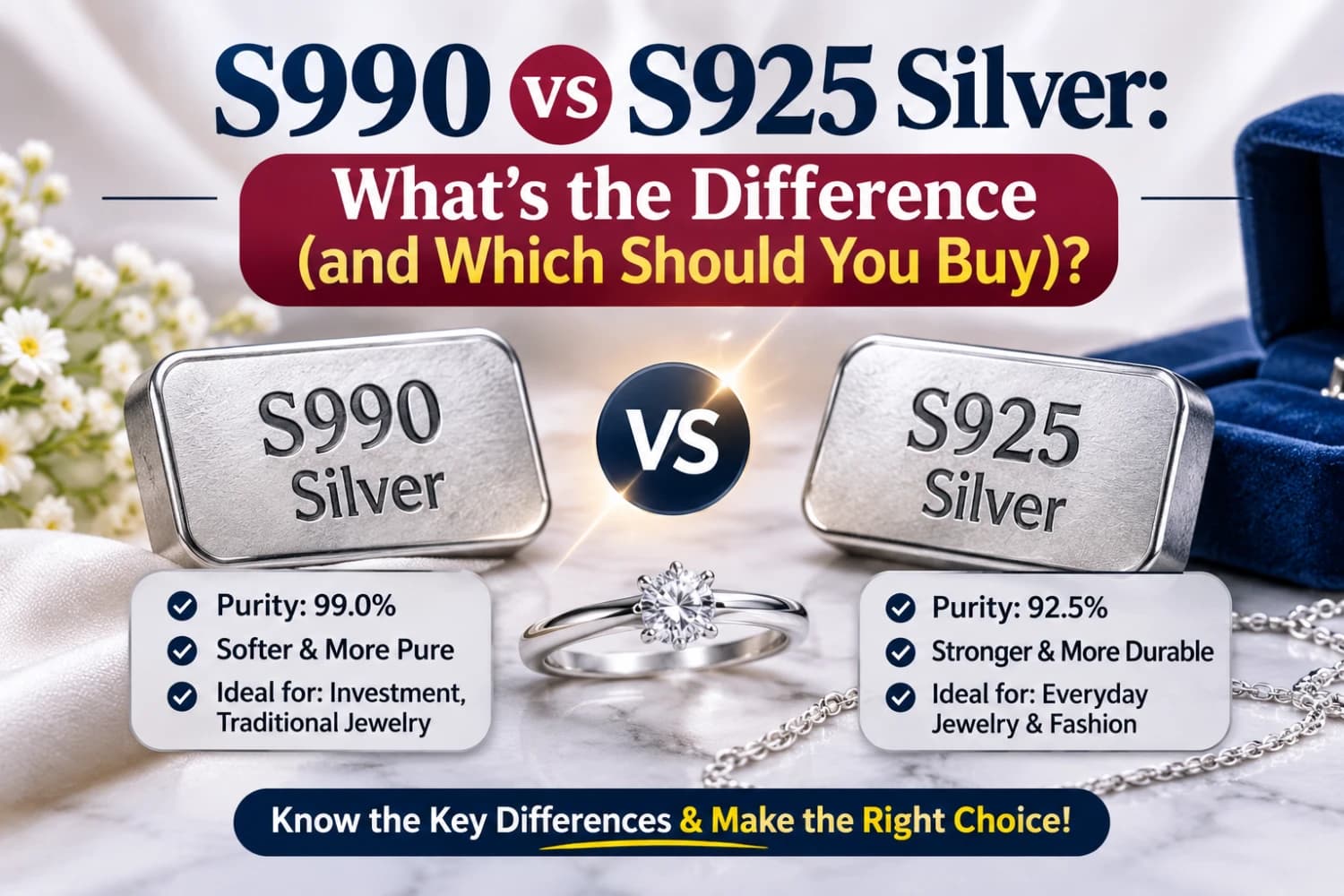
S990 is 99% pure silver. S925 is 92.5% silver, also called sterling silver. The 990 piece has a little more silver in it. The 925 piece is harder, holds stones better, and keeps its shape longer. For most jewelry you'll wear every day, sterling is the smarter buy. For a plain, chunky bangle or a keepsake you rarely wear, 990 is a lovely choice.
We've been casting, setting and polishing silver in our Jaipur workshop for over 15 years, and we ship to jewelry brands and shoppers across the US. So this guide goes past the definitions. You'll learn how the two metals actually behave on your wrist, what a stamp legally means in the United States, how much the extra silver is really worth, and how to tell real silver from a fake.
S990 vs S925 at a glance
| S990 silver | S925 sterling silver |
Silver content | 99.0% | 92.5% |
Other metals | 1% | 7.5% (mostly copper) |
Common names | 990 silver, "pure" or "fine" silver (in Asian markets) | Sterling silver, 925, .925 |
Hardness | Soft; bends, dents and scratches easily | Roughly twice as hard; keeps its shape |
Holds gemstones? | Poorly; prongs can loosen | Yes; the standard for stone settings |
Color | Slightly whiter, softer glow | Bright, cool white when polished |
Tarnish | Tarnishes, but usually more slowly | Tarnishes faster because of the copper |
Plating | Rarely plated | Often rhodium- or gold-plated |
Best for | Thick bangles, plain cuffs, baby keepsakes, heirloom pieces | Rings, earrings, chains, pendants, anything with stones |
Can it be called "sterling" in the US? | Technically yes, since it exceeds 92.5%, but it's almost always sold as "990" | Yes |
What does S925 mean?
S925 means the metal is 925 parts silver out of 1,000. The other 75 parts are alloy metals, almost always copper, sometimes with a touch of zinc or germanium. That recipe is called sterling silver, and it's been the benchmark for silver jewelry and tableware since medieval England.
Why not just use pure silver? Because pure silver is soft. Really soft. You can bend a thin fine-silver wire with your fingers. Adding a little copper stiffens the metal without changing its look much. That's what lets a jeweler cast a delicate ring, set a stone in tiny prongs, or make a chain clasp that snaps shut instead of bending open.
You'll see sterling marked several ways, and they all mean the same thing:
● 925 or .925: the common mark on pieces made in the US, Europe and India
● S925: the same metal, marked the way many Asian factories do it
● Sterling, Ster. or Sterling Silver: spelled out, common on American and vintage pieces
● Ag925: "Ag" is the chemical symbol for silver
What does S990 mean?
S990 means 990 parts silver out of 1,000, or 99% pure. Only 1% is something else. It's sometimes called "pure silver" or "fine silver," though in the US the term "fine silver" usually refers to 999 (99.9%). So if a seller calls 990 "fine silver," they're using the Asian-market sense of the word, not the American one.
If you've never seen an S990 stamp in a US mall jewelry store, there's a reason. S990 is mostly a Chinese and East Asian standard. It's popular there for a few cultural reasons:
● Baby gifts. Silver "longevity locks" and baby bangles are traditional gifts for newborns in China. Families want the purest silver they can get for a child's skin.
● Plain, heavy bangles. Thick, simple bangles don't need hardness. A soft metal is easy to slip on and gently squeeze to fit.
● Value you can melt down. In many Asian markets, 990 jewelry is bought partly for its metal. It's easy to trade in by weight and remake into something new.
Which is harder and more durable?
Sterling silver (925) is clearly harder than 990. In its softened, freshly annealed state, sterling is roughly twice as hard as near-pure silver. Once it's been hammered, rolled or polished, the gap grows even wider.
We point this out because one of the top-ranking pages on this topic says the opposite. It's an easy mistake to make if you assume "purer" means "stronger." With silver, it works the other way around. That extra 6.5% of copper is what gives sterling its backbone.
Here's what that difference looks like in real life:
● Rings. A 990 ring worn daily can slowly go oval and pick up dents. Sterling holds a round shape for years.
● Stone settings. Prongs in 990 bend easily, so a stone can loosen or fall out. That's why you almost never see faceted gemstones set in 990.
● Chains and clasps. Thin 990 chains stretch and kink. Spring clasps need sterling or something even harder.
● Fine details. Sharp edges and crisp engraving wear down faster on 990. On sterling, they stay sharp.
Does S990 or S925 tarnish faster?
Both tarnish, but sterling usually tarnishes faster. Several popular articles claim sterling "resists oxidation." That's backwards.
Tarnish is a thin black layer of silver sulfide. It forms when silver reacts with sulfur in the air, in sweat, in rubber bands, in wool and even in some foods like eggs and onions. Pure silver reacts slowly. Copper reacts fast, and copper is what makes up most of the extra 7.5% in sterling. So the more copper in the mix, the quicker a piece dulls.
Why do people believe the opposite? Mostly because of plating. A lot of sterling jewelry is sold with a thin coat of rhodium, a bright white metal from the platinum family. Rhodium doesn't tarnish, so a rhodium-plated sterling ring stays shiny for a long time. That's the plating at work, not the sterling.
A few practical takeaways:
● Unplated sterling needs a quick polish every few weeks if you wear it a lot, or if you live somewhere humid.
● Rhodium-plated sterling stays bright longer but will eventually wear through on high-contact spots like ring bands.
● 990 silver dulls more slowly, yet its softness means it scratches more easily, so it can look worn in a different way.
● Green skin comes from the copper in sterling reacting with sweat or lotion. It's harmless and doesn't mean the piece is fake. 990 rarely does this.
Is S990 worth more than S925?
By weight, S990 holds about 7% more silver than S925. In dollars, that difference is usually smaller than people expect.
Here's the simple math. Silver is priced per troy ounce, which is 31.1 grams. Take a 20-gram bangle and assume silver is trading at $50 an ounce, just to keep the numbers round:
20-gram bangle | Pure silver inside | Melt value at $50/oz |
S925 sterling | 18.5 g | about $29.74 |
S990 | 19.8 g | about $31.83 |
S999 fine | 19.98 g | about $32.12 |
That's a gap of roughly two dollars between 925 and 990. Plug in today's spot price and the gap scales up or down, but it stays small.
So why can a 990 bangle cost noticeably more, or less, than a sterling one? Because the retail price of jewelry is mostly design, labor, stones, plating and brand, not metal. A detailed sterling ring with hand-set stones can easily outprice a plain, heavy 990 bangle.
Two more things to know before you think of silver jewelry as an investment:
● Resale is lower than retail. Scrap buyers and refiners pay a percentage of melt value, not what you paid at the counter.
● Bullion is a different product. If you're buying silver purely as a store of value, coins and bars in 999 are the standard. Jewelry is for wearing.
How to tell if S925 or S990 silver is real
A stamp is a good start, but stamps can be faked. Use these checks in order, from easiest to most reliable:
Find the stamp and the maker's mark. Look inside ring bands, on clasps, and on the back of pendants. On US-sold pieces, a maker's mark should sit beside the 925.
Try a magnet. Silver isn't magnetic. If the piece snaps to a strong magnet, it's not solid silver. Passing the test doesn't prove it's real, though, since brass and copper aren't magnetic either. Ignore steel springs inside clasps.
Do the ice cube test. Silver conducts heat better than any other metal. Set an ice cube on a flat part of the piece. On real silver, it starts melting almost instantly.
Rub it with a white cloth. Real unplated silver often leaves a faint gray-black mark from tarnish. Rhodium-plated sterling won't, so a clean cloth isn't a red flag by itself.
Ask a jeweler for an acid test. A drop of silver-testing solution on a hidden spot turns bright red on fine silver, darker red on sterling, and brown or green on lower grades.
Get an XRF test for anything valuable. X-ray fluorescence reads the metal without damaging it. Many jewelers and pawn shops offer it, and it's the standard for checking wholesale orders.
How to care for S990 and S925 silver
The routine is almost the same for both. The difference is how gentle you need to be. 990 is softer, so it scratches more easily. Sterling tarnishes faster, so it needs polishing more often.
Do:
● Wear it. Regular wear and the friction of skin actually help keep silver bright.
● Wipe each piece with a soft cloth after wearing to remove sweat and lotion.
● Polish with a treated silver cloth. For 990, use light pressure and fewer passes.
● Clean grime with warm water, a drop of mild dish soap and a soft baby toothbrush. Dry it completely.
● Store pieces separately in zip bags or a lined box with an anti-tarnish strip. 990 pieces especially shouldn't rub against other jewelry.
Don't:
● Use toothpaste or baking soda on polished pieces. Both are abrasive and leave fine scratches, which show badly on soft 990.
● Soak pieces in vinegar for hours or dip them in harsh silver dips over and over. Dips strip plating and can damage stones and oxidized details.
● Use a silver polishing cloth on rhodium-plated sterling. You'll wear the plating off. A plain soft cloth is enough.
● Wear silver in a chlorinated pool or hot tub. Chlorine and sulfur speed up tarnish and can pit the surface.
● Spray perfume or hairspray while wearing it. Put jewelry on last.
Other silver stamps you might see
990 and 925 aren't the only numbers out there. Every silver stamp is just parts per thousand. Here's the rest of the family, from purest down:
Stamp | Silver content | Name and where you'll see it |
999 / S999 | 99.9% | Fine silver. Bullion coins and bars, wire-wrap and bezel wire, metal clay jewelry |
990 / S990 | 99.0% | Chinese and Asian "pure silver" jewelry; also some Karen Hill Tribe silver from Thailand |
958 | 95.8% | Britannia silver, a UK standard that's purer than sterling |
950 | 95.0% | Common on Mexican and Japanese silver, and some artisan pieces |
935 | 93.5% | Argentium sterling, tarnish-resistant |
925 / S925 | 92.5% | Sterling silver, the worldwide jewelry standard |
900 | 90.0% | Coin silver, found on older American silverware |
800 | 80.0% | Older European silver; under FTC guidance it shouldn't be sold simply as "silver" or "sterling" |
925 vs 950: which is better? 950 has a little more silver and a slightly whiter look, but it's softer. Many Mexican silversmiths use it for chunky, handmade pieces. For rings and stone settings, 925 is still the safer pick.
Is 999 worth more than 925? Per gram of metal, yes, by about 8%. But 999 is too soft for most jewelry, so in wearable pieces the craftsmanship usually matters more than that small difference in metal.
What's "S990 gold"? That's a different metal entirely. 990 gold is 99% pure gold, roughly 24 karats, popular in Asian markets. It has nothing to do with silver except the number.
If you're a brand or retailer sourcing silver jewelry
For a collection you'll sell in the US, sterling is almost always the right base metal. It's what American customers recognize, it's the only base that qualifies for gold vermeil, and it survives returns, shipping and daily wear far better than 990.
A few things we'd ask any supplier, including us:
● Is the alloy nickel-free and lead-free? Ask for it in writing.
● Which stamp will you use? For US sales, "925" plus your own trademark is the cleanest choice. An "S925" stamp is legal, but American shoppers often read it as an import signal.
● Can you put my maker's mark next to the quality mark? Under the Stamping Act, the trademark is your responsibility as the seller.
● What's the plating spec? Get the rhodium or gold thickness in microns, and confirm vermeil meets the 2.5-micron, 10K minimum.
● Can I test a sample? Order samples first and have them XRF-tested before you place a bulk order.
Frequently asked questions
Is S990 silver real silver?
Yes. S990 is 99% pure silver, which is purer than sterling. It's real, solid silver, just softer than the sterling most US jewelry is made from.
Is S925 silver real or fake?
A genuine S925 piece is real sterling silver, the same as anything stamped 925. The catch is that anyone can stamp "S925" on brass. Buy from sellers who list the alloy clearly, and use the magnet and ice cube tests if you're unsure.
Is S990 better than S925?
It depends on the piece. S990 has more silver and tarnishes more slowly. S925 is harder, holds stones, and keeps its shape. For rings, earrings and chains, sterling is the better choice. For a plain bangle or baby gift, 990 works beautifully.
Can I shower or swim in S990 or S925 jewelry?
A quick rinse won't hurt the metal, but soap film dulls it and chlorine speeds up tarnish. Take silver off before swimming, hot tubs and long showers, especially if it's plated or set with stones.
Will S990 or S925 turn my skin green?
Sterling occasionally leaves a faint green mark because of its copper. It's harmless and washes off. S990 has very little copper, so it rarely does this.
Is S990 or S925 better for sensitive skin?
990 is often gentler because it has less alloy metal. Most people wear sterling with no problems, but if you're allergic to nickel, look for pieces sold as nickel-free.
Can S925 and S990 rings be resized?
Usually, yes. A jeweler can resize most plain sterling and 990 rings. Rings with stones all the way around, or heavy plating, are harder and may need to be remade.
Does S925 jewelry have resale value?
Yes, but expect a fraction of the retail price. Scrap buyers pay based on silver weight and the day's spot price, minus their margin. Designer pieces can sell for more.
The bottom line
S990 is purer. S925 is tougher. That's the whole trade-off in four words.
If you want a ring that stays round, earrings that stay closed, or a gemstone that stays put, choose sterling. If you want a simple, heavy bangle or a meaningful baby gift with as much silver as possible, 990 is a beautiful option. Either way, the real markers of quality are a clear stamp, a seller you can trust, and a piece that's well made.
Looking for well-made sterling? Browse our 92.5 sterling silver jewelry collection, or send us your own design and we'll make it for you.
Shop This Category
Carabiner Lock
Wholesale Custom Jewelry Manufacturers
Maroth Jewels is a leading manufacturer specializing in 92.5 Sterling Silver, 14K/18K Gold, and Gemstones jewelry. We support designers and retail brands worldwide.
Request Bulk QuoteLooking for more articles?
Browse all blogs