Why Are Wedding Rings Worn on the Left Hand? History, Meaning and Global Traditions
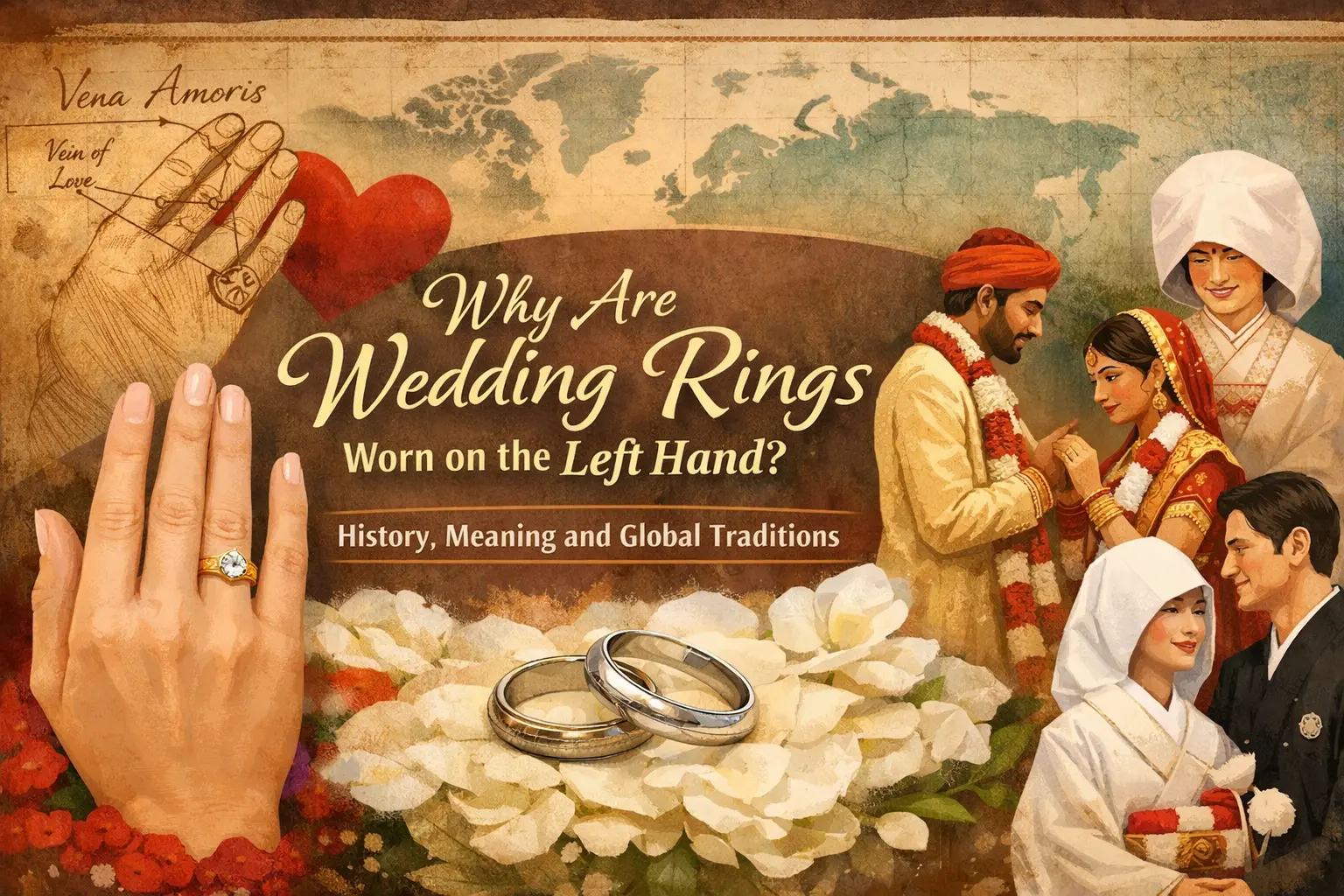
Why Are Wedding Rings Worn on the Left Hand? History, Meaning and Global Traditions
Introduction
Couples often ask us something surprisingly simple when they visit our showroom.
Why does the wedding ring go on the left hand
Some assume it is just a romantic tradition. Others believe it has a religious meaning. A few even think it is simply a modern marketing habit created by jewelry brands.
The truth is more interesting.
In our experience at Maroth Jewels many clients start researching engagement rings and wedding bands long before the proposal. During those conversations the same questions come up again and again.
Which hand should the wedding ring go on
Why the fourth finger
Why not another finger
Why do some countries wear it on the right hand
These questions matter more than people expect. A wedding ring is not just jewelry. It is worn every day for decades. The placement of that ring becomes part of a couple’s identity.
Across most Western countries the wedding ring is traditionally worn on the fourth finger of the left hand. This finger is often called the ring finger. The belief goes back thousands of years. Ancient civilizations thought a special vein connected that finger directly to the heart.
Modern science tells us that belief is not anatomically correct. Yet the symbolism stayed strong. Love commitment and connection are powerful ideas. Traditions built around them rarely disappear.
In our years working with couples we have seen something interesting. Most people follow the tradition without thinking too deeply about it. Others want to understand the history before choosing how they will wear their rings.
Both approaches are perfectly valid. A tradition only becomes meaningful when people understand what it represents.
That is exactly what we will explore here.
This guide explains why wedding rings are worn on the left hand. We will look at the history of the ring finger the ancient beliefs that shaped the tradition and how different cultures wear wedding rings today.
Along the way we will also share insights from our work designing wedding jewelry for real couples.
Because when it comes to wedding rings tradition is important. But personal meaning matters even more.
PART 1 Understanding the Ring Finger
What Is the Ring Finger?
The ring finger is the fourth finger of the human hand. It sits between the middle finger and the little finger.
In anatomy the finger is often referred to as the fourth digit. In everyday language it became known as the ring finger because of its connection to wedding and engagement rings.
This association is not universal though. Some cultures place wedding rings on different fingers or even different hands. Still the fourth finger has become the most widely accepted location for wedding rings.
Anatomy of the Fourth Finger
From a physical standpoint the ring finger is not very different from the other fingers. Each finger has arteries veins nerves and bones connected through the hand.
There is no special vein that runs only from the ring finger to the heart. That idea was widely believed for centuries but medical science later disproved it.
Still the ring finger has certain characteristics that made it a practical place for jewelry.
It is less active than the index or middle finger. It also experiences less pressure during daily tasks. This means rings worn on this finger tend to face less impact.
That small detail matters more than people think.
When clients at Maroth Jewels ask us about durability we often discuss finger placement. Rings worn on highly active fingers experience more scratches and structural stress over time.
The ring finger naturally offers a bit more protection.
Why It Became Associated With Marriage?
Tradition rarely forms around practicality alone. Symbolism usually plays a bigger role.
Over centuries the fourth finger became connected with ideas of love and commitment. Ancient cultures believed emotional energy or life force flowed through specific parts of the body. The ring finger was thought to carry that connection.
Once this belief became popular the tradition spread quickly across societies.
Why the Fourth Finger Became the Ring Finger?
Language often preserves history in interesting ways.
Across many cultures the fourth finger developed names that referenced rings love or even magic.
In Latin the finger was called digitus annularis which means the ring finger. The word annulus means ring.
Other languages developed their own interpretations.
In some Asian languages the finger translates roughly to nameless finger. This reflects the idea that the finger was reserved for a special purpose.
In Japanese tradition the finger was sometimes called the medicine finger. Ancient healers believed medicine applied with that finger held special healing properties.
These names show something fascinating.
People across different civilizations viewed the fourth finger as unique long before modern wedding traditions formed.
Historical Associations With Love and Commitment
The strongest association came from ancient Roman culture.
Romans believed a vein ran directly from the fourth finger of the left hand to the heart. They called it vena amoris which means vein of love.
The belief was poetic even if it was not medically accurate.
Placing a wedding ring on that finger symbolized love flowing directly between two hearts. That idea resonated deeply with people.
Many traditions fade away over time. This one stayed.
Even today couples often say the ring sits closest to the heart. While that is symbolic rather than anatomical the meaning remains powerful.
PART 2 Ancient Origins of the Tradition
The Ancient Egyptian Origin of Wedding Rings
The idea of wedding rings existed long before modern engagement culture.
Ancient Egyptians are often credited with creating the earliest form of marriage rings. Archaeological evidence shows rings made from braided reeds leather and bone being exchanged between partners thousands of years ago.
Those early rings carried a symbolic meaning.
They represented eternity.
A circle has no beginning and no end. Ancient Egyptians believed this shape reflected the endless nature of love and commitment.
That symbolism still influences wedding ring design today.
Even modern diamond rings follow the same basic principle. The circular band represents continuity. A promise that extends forward without a defined ending.
In our experience designing wedding bands at Maroth Jewels this symbolism still matters to couples.
Some clients choose extremely minimal bands specifically because they want that simple eternal circle to remain the focus.
Circular Rings Representing Eternity
The circular shape is powerful because it communicates something instantly.
No corners
No end
No interruption
Just continuity.
Many ancient cultures adopted the circle as a symbol of life unity and spiritual balance. When used in marriage jewelry the meaning became even stronger.
The ring becomes a physical reminder of an emotional promise.
The Roman Belief in the Vena Amoris
The Roman interpretation of wedding rings pushed the symbolism further.
Romans believed the fourth finger contained a vein directly connected to the heart. They called this vein vena amoris.
The phrase translates to vein of love.
This belief made the left ring finger the natural place for wedding jewelry.
Placing the ring there meant the symbol of commitment sat directly above the path to the heart.
The concept spread rapidly throughout Roman society.
Engagement rings and betrothal rings became common in Roman marriages. These rings often signified a legal agreement between families as well as romantic commitment.
Why Romans Believed the Finger Connected to the Heart?
Ancient medical understanding was limited compared to modern science. Observations about the body often turned into symbolic interpretations.
The heart had long been associated with emotions love and life force.
Connecting the ring finger to the heart made the tradition emotionally powerful.
Even after medical science disproved the vein theory the symbolism remained too meaningful to abandon.
The Symbolism of the Circle in Marriage
Beyond the finger itself the ring carries its own symbolism.
A wedding ring is intentionally simple in shape.
The band forms a continuous loop. No start. No finish.
That simplicity reflects a deeper message.
Marriage represents continuity partnership and commitment over time.
When couples choose wedding rings today they often focus heavily on gemstones or metal type. Those details matter. Yet the circle itself remains the most meaningful part.
At Maroth Jewels we sometimes remind clients of this when they feel overwhelmed by design choices.
A wedding ring does not need to be complicated to carry significance.
Sometimes the simplest design tells the strongest story.
PART 3 Historical Evolution of Wedding Ring Traditions
Wedding Rings in Ancient Greece and Rome
Greek culture adopted many Roman traditions including wedding rings.
In ancient Greece rings were often used during betrothal ceremonies rather than the wedding itself.
These rings symbolized trust between families. The groom gave a ring to the bride's family as a sign of commitment and responsibility.
Romans later expanded this concept.
Roman brides often received rings made from iron. The metal represented strength and permanence. Gold rings later became more common among wealthier families.
These rings marked both emotional and legal commitment.
Medieval Christian Wedding Ring Traditions
Christian wedding ceremonies began incorporating rings during the Middle Ages.
Interestingly the ring was not always placed directly on the ring finger.
During some medieval ceremonies priests placed the ring on three fingers in sequence.
Thumb
Index finger
Middle finger
Each placement symbolized the Holy Trinity.
After this sequence the ring was finally left on the fourth finger. Over time that final position became standard.
The ritual slowly evolved into the tradition most couples follow today.
Royal Influence on Wedding Ring Placement
Royal decrees sometimes shaped wedding traditions.
One notable example involved King Edward VI of England during the sixteenth century. Historical accounts suggest he supported the custom of wearing wedding rings on the fourth finger of the left hand.
Royal endorsement helped standardize the practice across parts of Europe.
As European influence spread globally the tradition followed.
Colonial expansion trade and migration carried wedding customs into new regions.
That is why countries like the United States Canada and Australia still follow the left hand tradition today.
PART 4 The Science Behind the Ring Finger Myth
Is the Vein of Love Real
Modern anatomy shows that the vein of love does not exist.
All fingers connect to the circulatory system through similar networks of veins and arteries.
There is no single vein that runs directly from one finger to the heart.
Yet the story persists.
Why
Because the idea is beautiful.
Symbolism often survives even when science changes our understanding.
Many couples know the myth is not scientifically accurate yet they still love the meaning behind it.
In jewelry design emotional symbolism often matters more than biological accuracy.
Why the Left Hand Became Symbolically Important?
The left hand gained symbolic importance for several reasons.
First cultural beliefs linked the left side of the body with emotional expression and intuition.
Second the heart sits slightly left of center in the human chest. This reinforced the poetic connection between the left hand and emotional closeness.
Over centuries this symbolism strengthened the tradition.
Even today when couples place a ring on the left hand the gesture still carries emotional significance.
PART 5 Wedding Ring Traditions Around the World
Countries That Wear Wedding Rings on the Left Hand
Many countries follow the left hand tradition.
United States
United Kingdom
Canada
France
Italy
Australia
These traditions spread largely through European influence.
In these regions engagement rings and wedding rings typically remain on the left ring finger.
Countries That Wear Wedding Rings on the Right Hand
Some cultures prefer the right hand.
Germany
Russia
Greece
Poland
Norway
In these regions the right hand symbolizes strength honesty and social commitment.
Countries Where the Ring Moves Between Hands
Certain cultures move the ring between hands during different stages.
Engagement rings may be worn on one hand before marriage. After the ceremony the ring moves to the other hand.
Germany and the Netherlands often follow this pattern.
PART 6 Religious Wedding Ring Traditions
Christian Wedding Ring Traditions
Christian ceremonies often place the ring on the left ring finger. Differences exist between Catholic Protestant and Orthodox traditions.
Orthodox Christians sometimes wear wedding rings on the right hand.
Jewish Wedding Ring Customs
Traditional Jewish ceremonies place the ring on the index finger during the wedding.
After the ceremony the bride typically moves the ring to the ring finger.
Muslim Wedding Ring Traditions
Wedding rings are not historically required in Islamic weddings.
Modern couples often adopt the practice through cultural influence.
Rings may appear on either hand depending on the region.
Indian Wedding Ring Traditions
Traditional Indian weddings focused more on symbolic jewelry such as mangalsutra necklaces.
Modern engagement culture introduced rings more widely. Women often wear engagement rings on the left hand while men sometimes choose the right.
PART 7 Engagement Rings vs Wedding Rings
Which Hand Does the Engagement Ring Go On?
Most Western cultures place the engagement ring on the left ring finger.
This allows the wedding band to sit below it during the ceremony.
What Happens to the Engagement Ring After Marriage?
Some brides temporarily move the engagement ring to the right hand during the ceremony. After the wedding both rings return to the left hand.
How to Wear Wedding and Engagement Rings Together?
Common arrangements include stacking rings on the same finger.
Some couples choose to solder the rings together for stability.
At Maroth Jewels we often recommend stacking first. Soldering can happen later once the couple knows they prefer that arrangement.
PART 8 Practical Reasons for Wearing Rings on the Left Hand
Comfort and Protection for Right Handed People
Most people are right handed.
Wearing a ring on the left hand reduces scratches and impact damage.
This practical advantage likely helped reinforce the tradition.
Lifestyle and Professional Considerations
Athletes medical professionals and craftsmen sometimes remove rings during work.
Others wear rings on chains around the neck for safety.
Comfort always matters.
PART 9 Modern Wedding Ring Trends
Breaking Traditional Wedding Ring Rules
Many couples now personalize how they wear rings.
Some choose alternative fingers.
Others skip engagement rings entirely.
Alternative Ways to Wear Wedding Rings
Necklaces
Tattoo rings
Minimalist bands
Tradition still matters but flexibility has grown.
PART 10 Frequently Asked Questions
Q1. Can You Wear a Wedding Ring on the Right Hand
Ans1. Yes many cultures do.
Q2. Do Men and Women Wear Wedding Rings on the Same Hand?
Ans2. Most couples match traditions but personal preference varies.
Q3. Why Do Some Cultures Wear Rings on the Right Hand?
Ans3. Religious cultural and historical beliefs influence the choice.
Q4. Can You Wear Your Wedding Ring on Another Finger?
Ans4. Yes though the ring finger remains the most common.
Q5. Why Is the Ring Finger the Fourth Finger?
Ans5. Historical tradition and symbolic association with love created the custom.
Conclusion
Wedding rings carry meaning far beyond jewelry.
The tradition of wearing them on the left hand grew from ancient symbolism cultural belief and centuries of shared practice.
Science may have disproved the vein of love yet the emotional meaning behind the tradition remains powerful.
At Maroth Jewels we see that meaning every day.
Couples choosing their rings are not just buying metal and gemstones. They are selecting a symbol they will wear for decades.
The hand and finger matter less than the commitment behind the ring.
Traditions give that commitment a story. The couple gives it life.
Shop This Category
Rings
Wholesale Custom Jewelry Manufacturers
Maroth Jewels is a leading manufacturer specializing in 92.5 Sterling Silver, 14K/18K Gold, and Gemstones jewelry. We support designers and retail brands worldwide.
Request Bulk QuoteLooking for more articles?
Browse all blogsLatest Products
View AllPrivate Lable 14K Yellow Gold Marquise Bloom Ear Jacket Earrings with Marquise CZ Stones Floral Statement Fine Jewelry
Private Lable 925 Silver Yellow Gold Plated Marquise Bloom Ear Jacket Earrings with Marquise CZ Stones Floral Statement Fine Jewelry
14K Yellow Gold CZ Lumera Apple Pendant Elegant Fruit Charm Designer Jewelry Supplier
925 Silver Yellow Gold Plated CZ Lumera Apple Pendant Elegant Fruit Charm Designer Jewelry Supplier
Wholesale 14K Yellow Gold Sylvara Tree Disc Pendant with CZ Minimalist Nature Inspired Circle Charm Handmade Jewelry
Wholesale 925 Silver Yellow Gold Plated Sylvara Tree Disc Pendant with CZ Minimalist Nature Inspired Circle Charm Handmade Jewelry
14K White Gold Minimal Rabbit Nature Inspired Bunny Animal Ring Manufacturer
925 Sterling Silver White Gold Plated Minimal Rabbit Nature Inspired Bunny Animal Ring Manufacturer
14K Yellow Gold Black CZ Velvet Poodle Minimalist Puppy Animal Ring Custom Jewelry
925 Silver Yellow Gold Plated Black CZ Velvet Poodle Minimalist Puppy Animal Ring Custom Jewelry
Contact Us For Custom Jewelry
Please get in touch with us and share your ideas if you have personalized jewelry or are searching for a private label jewelry manufacturer. In accordance with your suggestions, we will make and present genuine jewelry.
B2B Jewelry Manufacturer for Global Brands
Share your design, metal, plating, gemstone, and quantity requirements for a custom manufacturing quotation. We work in sterling silver and solid gold, including precious, semi-precious, lab diamond, and genuine diamond jewelry.
MOQ & Pricing
MOQ usually starts from 5 to 10 pieces depending on design. Sample pricing and quantity-based prices are available.
CAD & Production
CAD usually takes 3 to 4 working days. Sample production takes 25 to 30 days and bulk production takes 30 to 40 days.
Shipping
Shipping: 4 to 7 days worldwide.
Payments
We accept payments via PayPal, Payoneer, Wise, and bank transfer.