






How Do You Convert 24K Gold to 22K Gold? Complete Conversion Guide
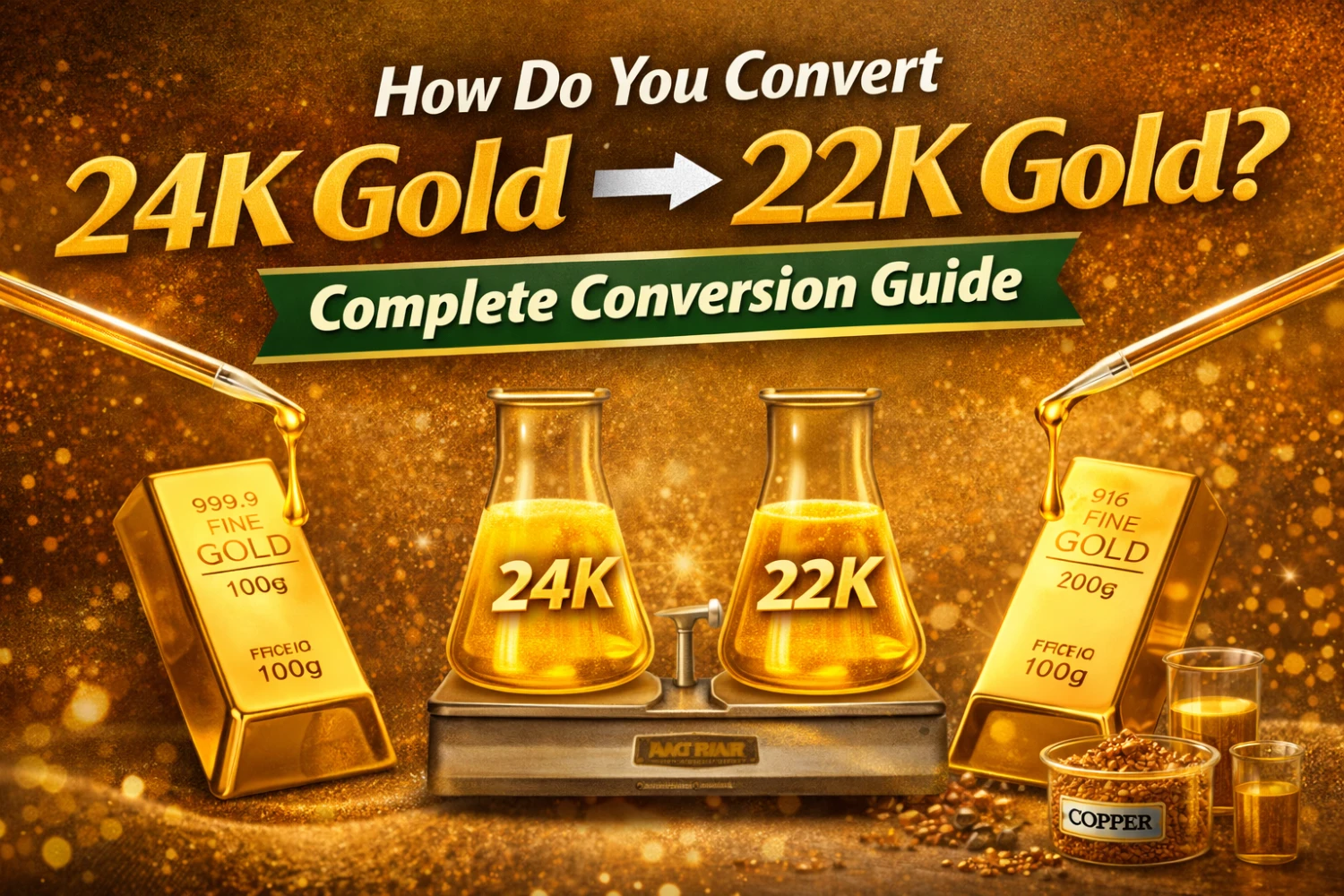
How Do You Convert 24K Gold to 22K Gold? Complete Conversion Guide
A surprising number of clients walk into our studio with the same question.
They inherited a small bar of pure gold from their family.
They bought investment gold coins years ago.
Or they simply own a piece of 24K gold that feels too soft to wear.
Then the question comes.
Can this be turned into proper jewelry
And more specifically
How do you convert 24K gold into 22K gold
This situation comes up more often than most people realize. Pure gold is beautiful but impractical for everyday jewelry. Rings bend. Bangles deform. Fine details disappear after years of wear.
At Maroth Jewels we see this especially with wedding jewelry. Clients want something durable enough for daily wear yet still rich in gold purity. That balance is exactly why 22K gold exists.
Many buyers assume the conversion is complicated. The truth is simpler. The process involves adjusting the metal composition so the final alloy contains slightly less pure gold and a small amount of strengthening metals.
Once you understand the math and the metallurgy the whole idea becomes clear.
This guide explains everything properly.
Gold purity basics
The actual formula jewelers use
Why weight changes during conversion
Real workshop methods used in jewelry studios
Common mistakes people make when trying to calculate purity
If you are researching gold for investment or jewelry design this clarity matters.
Gold is expensive. Even a small misunderstanding can cost real money.
So let's start with the foundation.
Understanding what karat actually means.
What Is Gold Karat?
Understanding Gold Purity
Most people hear terms like 24K or 22K their entire life without truly knowing what the numbers represent.
Gold karat measures purity.
The number tells you how many parts of pure gold exist inside a metal alloy out of a total of twenty four parts.
Think of gold as a pie cut into twenty four slices.
If all twenty four slices are pure gold you have 24K gold.
If twenty two slices are gold and two slices are other metals you have 22K gold.
That is the entire concept.
Definition of Karat in Gold
Karat represents the proportion of pure gold inside a metal mixture.
Jewelry rarely uses completely pure gold because pure gold is extremely soft.
So jewelers mix small quantities of other metals to strengthen it.
Those additional metals are called alloys.
Copper
Silver
Zinc
Sometimes palladium
These metals change durability color and strength.
But the karat number always tells you how much pure gold remains.
The 24 Part Purity System
The karat system divides gold purity into twenty four parts.
Here is how the math works.
24K equals 24 parts gold
22K equals 22 parts gold plus 2 parts alloy
18K equals 18 parts gold plus 6 parts alloy
14K equals 14 parts gold plus 10 parts alloy
Higher karat means higher gold purity.
Lower karat means more alloy metals.
How Gold Purity Is Measured?
Professional jewelers measure purity using two common systems.
Karat system
Millesimal fineness
The fineness system expresses purity as a decimal number.
Example
24K gold equals 999 or 99.9 percent gold
22K gold equals 916 or 91.6 percent gold
18K gold equals 750 or 75 percent gold
When clients bring gold jewelry to Maroth Jewels we usually confirm purity using a digital karat analyzer before doing any modification work.
It ensures we know exactly what metal composition we are starting with.
Accuracy matters because even a small error changes the final alloy.
What Is 24K Gold?
Pure gold holds a special place in both jewelry culture and investment.
Many families store wealth in 24K coins or bars. In some cultures pure gold symbolizes prosperity and security.
But pure gold has a practical limitation.
It is extremely soft.
Purity Level of 24K Gold
24K gold contains nearly one hundred percent pure gold.
The typical purity rating is 99.9 percent.
No other metal significantly changes its composition.
This purity gives it a deep rich yellow color that many people associate with traditional gold.
Characteristics of Pure Gold
Pure gold has several unique properties.
Very soft metal
Highly malleable
Extremely resistant to corrosion
Bright deep yellow color
A single gram of pure gold can be stretched into a very thin sheet.
That softness is both a strength and a weakness.
It allows jewelers to shape gold easily.
But it also means jewelry made from pure gold scratches bends and loses form.
Why 24K Gold Is Rarely Used For Jewelry?
In our experience at Maroth Jewels pure gold jewelry works best for ceremonial pieces.
Not daily wear items.
Rings are the biggest issue. Constant pressure from hands causes deformation.
Thin bangles also lose their round shape.
Detailed designs blur over time because soft metal wears down.
For this reason most wearable gold jewelry uses 22K or 18K alloys.
These alloys maintain high gold content while improving strength.
What Is 22K Gold?
22K gold represents a practical balance.
It still feels like high purity gold but performs better in jewelry.
Many traditional Indian and Middle Eastern jewelry styles rely heavily on 22K gold.
Composition of 22K Gold
22K gold contains
22 parts pure gold
2 parts alloy metals
Those alloy metals are usually copper or silver.
Sometimes both.
This small addition dramatically improves hardness.
Percentage of Pure Gold in 22K
Using the karat formula
Gold purity equals karat divided by twenty four multiplied by one hundred.
22 divided by 24 equals 0.916
So 22K gold contains approximately 91.6 percent pure gold.
The remaining 8.4 percent consists of alloy metals.
Why 22K Gold Is Widely Used in Jewelry?
Clients often ask us why jewelers favor 22K instead of pure gold.
The answer is durability.
22K jewelry holds shape better.
Stone settings stay secure.
Filigree patterns remain crisp.
Yet the metal still retains the rich golden color people love.
For wedding jewelry especially this balance is ideal.
Difference Between 24K Gold and 22K Gold
Understanding the differences helps explain why conversion happens.
Purity Comparison
24K gold contains about 99.9 percent gold.
22K gold contains about 91.6 percent gold.
That small difference changes how the metal behaves.
Durability and Hardness
24K gold bends easily.
22K gold resists bending because alloy metals strengthen the structure.
Color and Appearance Differences
Pure gold appears slightly brighter and deeper yellow.
22K gold still looks rich but may appear slightly toned depending on alloy composition.
Price Differences
Since 24K contains more pure gold it typically costs slightly more per gram.
But the difference becomes less important when designing wearable jewelry.
Durability often matters more than tiny purity differences.
Gold Purity Percentage Chart
Below is a simple reference chart many jewelers keep in workshops.
Karat | Gold Percentage
24K | 99.9 percent
23K | 95.8 percent
22K | 91.6 percent
21K | 87.5 percent
20K | 83.3 percent
18K | 75 percent
14K | 58.3 percent
10K | 41.7 percent
This chart helps quickly estimate purity when analyzing gold items.
Basic Gold Karat Conversion Formula
The most important formula used in gold conversion is simple.
Pure gold content equals total weight multiplied by karat divided by twenty four.
Pure gold equals weight multiplied by K divided by 24.
Jewelers use this formula constantly when melting gold.
It tells us how much pure gold exists in the starting material.
Once that number is known we can calculate the final alloy composition.
Formula to Convert 24K Gold to 22K Gold
The actual conversion formula looks like this.
Target weight equals pure gold weight divided by target karat divided by 24.
If we start with pure gold the calculation becomes easier.
Example
Final 22K weight equals pure gold weight divided by 0.916.
That result tells us how much final alloy will exist after adding metals.
Step by Step Calculation Example
Let's walk through a common example.
Suppose a client brings 10 grams of 24K gold.
We want to convert it into 22K gold.
Step one calculate gold purity.
24K gold contains 10 grams pure gold.
Step two calculate final alloy weight.
Final weight equals 10 divided by 0.916.
Result equals about 10.91 grams.
Step three calculate alloy metals.
10.91 minus 10 equals 0.91 grams.
So we add approximately 0.91 grams of alloy metals.
The result becomes 22K gold.
Why Weight Changes When Converting Gold Karats?
Clients often feel confused when the final weight increases.
The reason is simple.
Alloy metals add extra mass.
When we convert pure gold into 22K gold we mix additional metals to reach the correct purity ratio.
The pure gold amount stays the same.
But the total weight increases because new metals enter the mixture.
Alloy Metals Used to Make 22K Gold
Different metals influence strength and color.
Copper
Copper increases hardness and gives gold a slightly warmer tone.
Silver
Silver keeps the color brighter and improves flexibility.
Zinc
Zinc helps with casting and smooth metal flow during melting.
At Maroth Jewels we carefully balance these alloys depending on design requirements.
Stone setting jewelry often needs slightly different hardness compared to plain gold pieces.
How Jewelers Convert 24K Gold to 22K Gold?
This process happens inside a jewelry workshop.
First pure gold is melted in a crucible.
Temperature reaches roughly one thousand degrees Celsius.
Then pre measured alloy metals are added.
The molten mixture is stirred carefully to ensure uniform distribution.
Next the metal is poured into molds.
Once cooled the alloy becomes solid 22K gold ready for rolling casting or shaping.
Accuracy during this stage matters greatly.
Even small measurement errors change the karat level.
Practical Conversion Examples
5 grams 24K gold
Final weight approximately 5.45 grams 22K
10 grams 24K gold
Final weight approximately 10.91 grams 22K
50 grams 24K gold
Final weight approximately 54.6 grams 22K
These examples show how total weight increases after alloy addition.
Gold Value Calculation After Conversion
Jewelry pricing depends on multiple factors.
Base gold price per gram
Weight
Making charges
Taxes
A simplified formula looks like this.
Jewelry price equals gold rate multiplied by weight plus making charges plus tax.
How to Calculate Gold Value Using Gram Rate?
Suppose 22K gold price equals 6000 per gram.
If your jewelry weighs 10 grams
Gold value equals 6000 multiplied by 10.
Total equals 60000.
Making charges and tax would be added separately.
Tools Used for Gold Karat Conversion
Modern jewelry workshops use specialized tools.
Digital karat analyzers
Precision gram scales
Gold purity calculators
These tools help maintain accuracy during melting and alloying.
Gold Hallmarking and Purity Verification
In India BIS hallmarking confirms purity.
22K gold carries the hallmark 916.
24K gold carries hallmark 999.
These markings protect buyers and ensure authenticity.
Common Mistakes in Gold Karat Conversion
Several errors appear frequently.
Incorrect alloy ratios
Poor measurement accuracy
Ignoring metal loss during melting
Professional jewelers account for these factors before starting conversion.
When You Might Need to Convert 24K Gold to 22K?
Conversion becomes useful in several situations.
Creating jewelry from investment gold
Custom jewelry design projects
Repairing heirloom pieces
Adjusting metal hardness for durability
At Maroth Jewels we often help clients convert inherited gold into wearable designs.
It allows sentimental metal to become meaningful jewelry again.
Frequently Asked Questions
Q1. Can you convert 24K gold to 22K at home?
Ans1. Technically possible but not recommended.
Proper alloy measurement and melting equipment are necessary.
Q2. How much alloy is added to 24K gold to make 22K?
Ans2. About eight percent alloy metals.
Q3. Does converting gold affect its value?
Ans3. The pure gold value remains the same. Total weight changes slightly.
Q4. Why is 22K gold stronger than 24K?
Ans4. Alloy metals strengthen the structure.
Q5. Is 22K gold still considered pure gold?
Ans5. Yes. It contains over ninety percent gold.
Q6. How to convert 24K gold price to 22K gold price?
Ans6. Multiply 24K price by 0.916.
Q7. How much is 1 gram of pure 24K gold?
Ans7. Depends on the current market rate.
Q8. How much is 1 gram of 22K gold?
Ans8. About ninety one percent of the 24K rate.
Q9. How to convert 24K to 18K gold?
Ans9. More alloy metals are added until purity reaches seventy five percent.
Conclusion
Gold conversion sounds complicated until you understand the logic behind it.
24K gold contains pure metal but lacks durability.
22K gold introduces a small amount of alloy metals that improve strength while preserving rich gold content.
The conversion process simply adjusts that balance.
Pure gold amount remains constant.
Total weight changes slightly because additional metals are added.
Understanding this process helps buyers evaluate jewelry more confidently.
Clients who work with us at Maroth Jewels often arrive with gold they inherited or purchased as investment. Converting that metal into durable jewelry allows them to keep the value while creating something meaningful they can actually wear.
Gold has always been both wealth and memory.
Handled carefully it becomes something that lasts generations.
Recent Posts
 -65%
-65%
14K Yellow Gold Plated Bead Finding With Cubic Zircon Jewelry Supplier
-60%
925 Silver Gold Plated Bead Finding With Cubic Zircon Jewelry Supplier
 -60%
-60%
Private Label 925 Natural Silver Pave Blue Sapphire Round Beads Finding
 -60%
-60%
 -60%
-60%
 -60%
-60%
Private Label 925 Silver Pave Diamond Oval Shell Shaped Finding Jewelry
 -60%
-60%
925 Silver Diamond Round Beads Handmade Connector Finding Jewelry Manufacturer
 -60%
-60%
 -60%
-60%
Private Label 925 Silver Round Beads Pave Diamond Connector Finding Jewelry
 -60%
-60%
925 Silver Pave Diamond Round Beads Handmade Connector Finding Jewelry USA
-65%
14K Yellow Gold Plated Bead Finding With Cubic Zircon Jewelry Supplier
-60%
925 Silver Gold Plated Bead Finding With Cubic Zircon Jewelry Supplier
-60%
Private Label 925 Natural Silver Pave Blue Sapphire Round Beads Finding
-60%
-60%
-60%
Private Label 925 Silver Pave Diamond Oval Shell Shaped Finding Jewelry
-60%
925 Silver Diamond Round Beads Handmade Connector Finding Jewelry Manufacturer
-60%
-60%
Private Label 925 Silver Round Beads Pave Diamond Connector Finding Jewelry
-60%
925 Silver Pave Diamond Round Beads Handmade Connector Finding Jewelry USA
Contact Us For Custom Jewelry
Please get in touch with us and share your ideas if you have personalized jewelry or are searching for a private label jewelry manufacturer. In accordance with your suggestions, we will make and present genuine jewelry.
B2B Jewelry Manufacturer for Global Brands
Share your design, metal, plating, gemstone, and quantity requirements for a custom manufacturing quotation. We work in sterling silver and solid gold, including precious, semi-precious, lab diamond, and genuine diamond jewelry.