List of the Most Valuable Birthstones by Rarity and Price
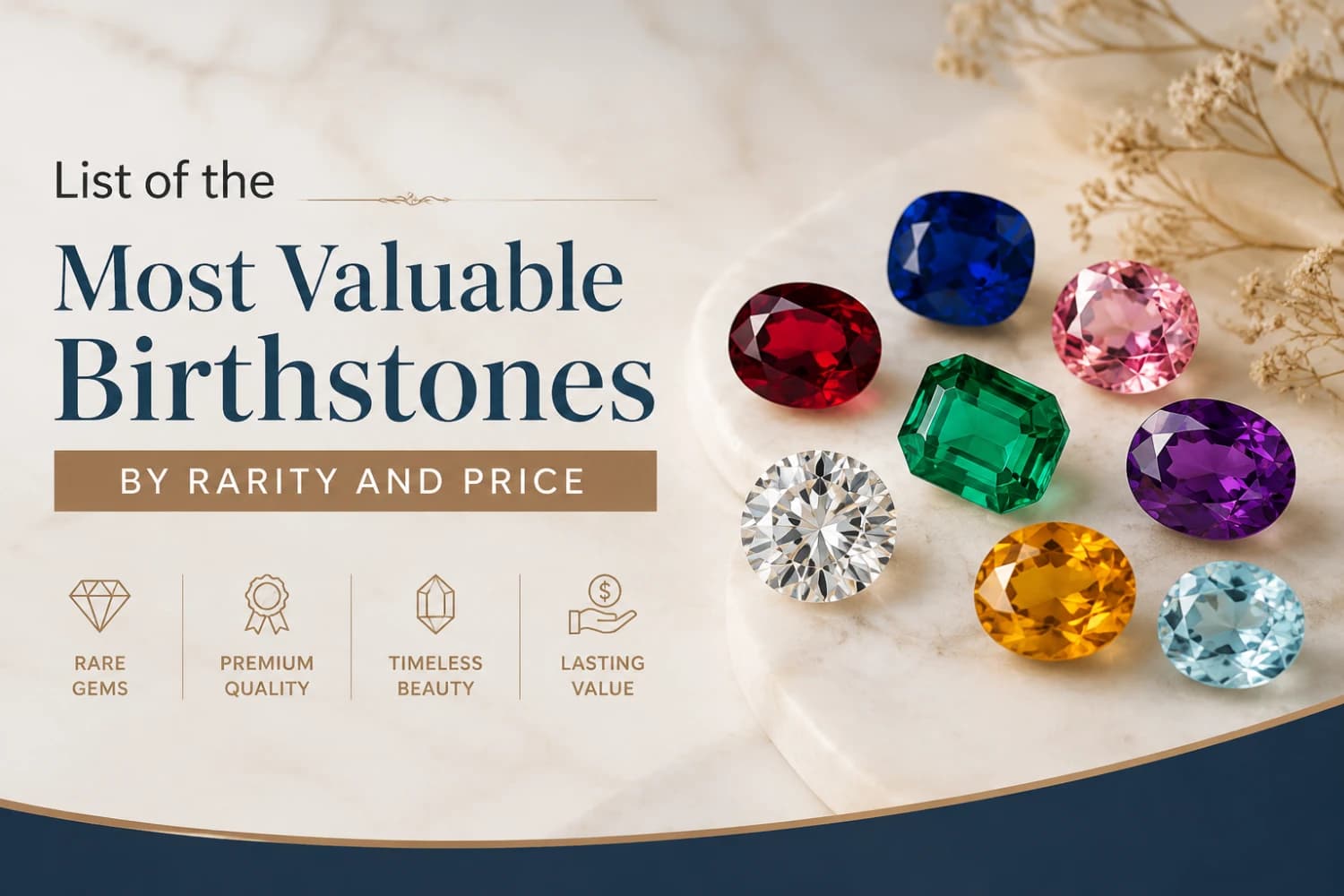
List of the Most Valuable Birthstones by Rarity and Price
Not all birthstones are created equal. A February amethyst can cost less than dinner for two, while a fine July ruby can sell for more per carat than a diamond. If you've ever wondered where your birthstone sits on the value ladder or which stones deserve a place in your jewelry collection or store inventory this guide breaks it all down.
Below you'll find a complete list of the most valuable birthstones ranked by rarity and price, a month-by-month value chart in US dollars, and the exact factors gemologists use to judge what a stone is worth. Whether you're a jewelry lover shopping for a meaningful piece or a US retailer planning your next birthstone collection, everything you need is here.
The most valuable birthstone overall is the diamond (April), with fine 1-carat stones starting around $3,000 and rare fancy-colored diamonds reaching six figures per carat. The rarest birthstone, however, is natural alexandrite (June) a color-changing gem so scarce that top-quality stones can exceed $50,000 per carat.
Birthstone Value Chart: All 12 Months by Rarity and Price (2026)
Here's the complete birthstone chart, month by month. Prices reflect typical US retail ranges for fine-quality natural stones per carat; exceptional specimens can sell far higher.
Prices are 2026 estimates for natural, untreated or minimally treated stones. Color, clarity, origin, and certification can move values dramatically in either direction.
The 10 Most Valuable Birthstones, Ranked
Ranked by a combination of top-end market price and genuine natural rarity the two forces that decide what any gemstone is truly worth.
1. Diamond April's Birthstone
Rarity: Rare in fine grades | Price: $3,000–$30,000+ per carat | Mohs: 10
Diamond tops the birthstone value list for good reason. It's the hardest natural material on Earth, which makes it the only birthstone that can genuinely handle a lifetime of daily wear. Colorless diamonds are graded D through Z, and each step toward D adds meaningful value a 1-carat D-flawless stone can command $20,000 or more.
The real fireworks happen with fancy-colored diamonds. Natural pink, blue, and red diamonds are among the rarest objects on the planet: the 59.6-carat Pink Star diamond sold at auction in 2017 for $71.2 million roughly $1.2 million per carat, a record that still frames the top of the entire gem market.
2. Ruby July's Birthstone
Rarity: Very rare untreated | Price: $1,000–$15,000+ per carat | Mohs: 9
Carat for carat, fine ruby is the most valuable colored gemstone in the world and top stones routinely outprice comparable white diamonds. The most coveted color is "pigeon's blood" red: a pure, vivid red with a whisper of blue, historically associated with Burmese (Myanmar) origin.
Auction results tell the story. The 25.59-carat Sunrise Ruby fetched $30.3 million in 2015 (about $1.18 million per carat), and the 55.22-carat Estrela de Fura from Mozambique sold for $34.8 million in 2023. Untreated rubies over 1 carat are genuinely scarce, which is why certification matters more here than with almost any other gem.
3. Alexandrite June's Birthstone
Rarity: Exceptionally rare | Price: $5,000–$70,000+ per carat | Mohs: 8.5
Alexandrite is the answer to "what is the rarest birthstone?" This chrysoberyl variety performs a magic trick no other major gem can: it appears green to bluish-green in daylight and shifts to red or purplish-red under warm indoor light "emerald by day, ruby by night."
Discovered in Russia's Ural Mountains in the 1830s and named for Tsar Alexander II, the original deposits are essentially exhausted. Today's supply trickles in from Brazil, Sri Lanka, and East Africa, and fine natural stones above 1 carat with a strong color change can exceed $50,000–$70,000 per carat. Most alexandrite sold in the US is lab-created beautiful, but worth a small fraction of natural material.
4. Emerald May's Birthstone
Rarity: Very rare in clean qualities | Price: $800–$10,000+ per carat | Mohs: 7.5–8
Emerald has symbolized wealth since Cleopatra's Egypt, and the finest stones saturated bluish-green, chromium-colored, from Colombia's Muzo and Chivor mines remain among the most expensive gems money can buy. The Rockefeller Emerald sold in 2017 for about $305,000 per carat, an auction record for the species.
Nearly every emerald contains internal inclusions the trade poetically calls jardin (French for garden), so buyers accept clarity characteristics that would sink a diamond's value. An emerald that's both richly colored and eye-clean is a genuine rarity and priced like one.
5. Sapphire September's Birthstone
Rarity: Rare | Price: $800–$10,000+ per carat | Mohs: 9
September's birthstone offers royal pedigree (think Princess Diana's engagement ring) with near-diamond durability. Velvety cornflower-blue stones from Kashmir sit at the summit historic Kashmir sapphires have surpassed $200,000 per carat at auction followed by fine material from Myanmar, Sri Lanka, and Madagascar.
Don't overlook padparadscha sapphire, the rare pink-orange variety named after the Sinhalese word for lotus blossom. It regularly outprices blue sapphire and has become a favorite of US collectors seeking something distinctive.
6. Paraíba Tourmaline October's Birthstone
Rarity: Exceptionally rare | Price: $5,000–$30,000+ per carat | Mohs: 7–7.5
Most tourmaline is affordable, but Paraíba is the exception that rewrote October's value story. Discovered in Brazil's Paraíba state in the late 1980s, its copper content produces an electric neon blue-green that seems to glow from within no other gem looks like it.
The original Brazilian deposits produced tiny quantities and are nearly mined out; copper-bearing tourmaline from Mozambique and Nigeria costs less but still ranks among the priciest colored stones. Fine Brazilian material above 3 carats is rarer than diamond by orders of magnitude.
7. Black Opal October's Birthstone
Rarity: Very rare | Price: $1,000–$10,000+ per carat | Mohs: 5.5–6.5
While common white opal stays affordable, black opal from Lightning Ridge, Australia is a different universe. Its dark body tone makes the play-of-color rolling flashes of red, blue, green, and orange burn with intensity, and stones showing dominant red fire command the strongest prices.
Top gem-quality black opals reach five figures per carat, making October (with Paraíba tourmaline as its co-star) a quietly expensive birth month.
8. Natural Pearl June's Birthstone
Rarity: Exceptionally rare (natural) | Price: Highly variable natural pearls sell for multiples of cultured | Mohs: 2.5–4.5
Pearl is the only birthstone created by a living creature, and natural pearls formed without human intervention have become so scarce that fine examples are essentially auction-house material. La Peregrina, a natural pearl once owned by Elizabeth Taylor, sold for $11.8 million.
The cultured pearls in most US jewelry stores are far more accessible: fine Akoya strands run into the low thousands, while top South Sea and Tahitian strands can reach $25,000–$100,000+. Roundness, luster, surface quality, and nacre thickness drive value.
9. Tanzanite December's Birthstone
Rarity: Rare single source on Earth | Price: $300–$1,200 per carat | Mohs: 6–7
Tanzanite is found in exactly one place: a few square miles in the Merelani Hills near Mount Kilimanjaro, Tanzania. Discovered in 1967 and launched to fame by Tiffany & Co., its velvety violet-blue made it the first gem added to the official US birthstone list in decades when it joined December in 2002.
That single-source status is a double-edged sword supply is genuinely finite, yet current production keeps prices accessible. Many gem professionals view fine tanzanite above 5 carats as significantly undervalued relative to its rarity.
10. Tsavorite Garnet January's Birthstone
Rarity: Rare | Price: $500–$3,000 per carat (fine 2ct+ stones higher) | Mohs: 6.5–7.5
Everyday red garnet costs $20–$100 per carat, but January hides an aristocrat: tsavorite, the vivid green garnet from Kenya and Tanzania that rivals emerald's color with better clarity and brilliance usually with no treatment at all. Clean stones over 2 carats are difficult to source and priced accordingly.
Its cousin, demantoid garnet, sparkles with more fire than diamond and features prized "horsetail" inclusions; fine Russian demantoids are collector trophies.
The Most Affordable Birthstones (Beautiful on Any Budget)
The good news for the remaining birth months: your gem delivers maximum beauty per dollar. Amethyst (February, $20–$100/ct) was once reserved for royalty until huge Brazilian deposits made it accessible. Citrine (November, $10–$50/ct) offers sunny golden warmth at the friendliest price on this list. Peridot (August, $50–$500/ct) is one of the few gems born in volcanic fire and occasionally in meteorites. Aquamarine (March, $100–$1,000/ct) rewards buyers seeking the deep-blue "Santa Maria" color. Turquoise (December, $10–$300/ct), blue topaz (November), moonstone (June), and zircon (December) round out the accessible tier.
Affordable doesn't mean lesser these stones let you go bigger in carat weight, bolder in design, and are ideal for the personalized birthstone jewelry that dominates US gifting trends.
Rarity vs. Price: Why They're Not the Same Thing
Here's the nuance most birthstone lists miss: the rarest stone isn't automatically the most expensive.
Natural alexandrite is far scarcer in the earth than diamond, yet diamond's global demand, marketing legacy, and bridal-market dominance keep it at the top of the price list. Tanzanite exists in only one deposit on the planet a rarity claim almost no gem can match yet steady mine output keeps it affordable for now. Meanwhile, red spinel (an alternate August birthstone) spent centuries being mistaken for ruby in royal crowns and still costs a fraction of the ruby prices it visually matches.
Price is what the market will pay today. Rarity is how hard nature made the stone to find. The smartest buyers and the smartest jewelry retailers look for gems where rarity hasn't been fully priced in yet: tanzanite, spinel, tsavorite, and fine zircon top that list in 2026.
What Determines a Birthstone's Value? (The 4 Cs and Beyond)
Color
For colored gems, color is 50–70% of the value equation. Gemologists grade hue, tone, and saturation a vivid, evenly distributed color with medium tone commands the premium. This is why "pigeon's blood" ruby and "cornflower" sapphire carry their own price tiers.
Clarity
Fewer visible inclusions mean higher value, but standards shift by species: an eye-clean aquamarine is expected, while an eye-clean emerald is a miracle priced accordingly.
Cut
A precise cut unlocks brilliance and can raise a stone's value by 20–30% over a poorly proportioned one. Windowed or overly deep cuts waste both light and money.
Carat weight
Prices rise exponentially, not linearly. A fine 2-carat ruby doesn't cost twice a 1-carat stone it can cost three to four times more, because large fine crystals are exponentially rarer.
Origin
Provenance adds real dollars: Burmese ruby, Colombian emerald, Kashmir sapphire, and Brazilian Paraíba all carry origin premiums confirmed by lab reports.
Treatment
Most rubies and sapphires on the US market are heat-treated accepted and stable, but untreated stones with lab certificates sell for 30–70% more. Always request a report from GIA, AGL, or an equivalent lab for any significant purchase.
Natural vs. lab-grown
Lab-grown diamonds, emeralds, and alexandrite are chemically identical to natural stones at 10–30% of the price. They're an excellent choice for design-driven jewelry but they don't carry the scarcity value of natural gems, and resale values remain minimal. Reputable sellers always disclose which you're buying.
Are Valuable Birthstones a Good Investment?
Fine natural gemstones untreated rubies, Colombian emeralds, Kashmir-type sapphires, natural alexandrite have historically held or grown their value, and auction records keep climbing. That said, gems are illiquid compared to stocks: buying at retail and selling wholesale means only genuinely rare, certified, top-quality stones tend to appreciate meaningfully.
The practical takeaway for most US buyers: purchase the finest quality you can afford, insist on independent certification, keep documentation, and buy first for love any appreciation is the bonus.
How to Choose the Right Birthstone Jewelry?
If you're buying for yourself or as a gift:
decide whether the birth month or the budget leads. A June birthday doesn't demand a $20,000 alexandrite a luminous pearl or moonstone honors the month beautifully. Prioritize color over carat weight, check the Mohs rating against how the piece will be worn (softer stones like opal and pearl belong in pendants and earrings rather than daily rings), and match the metal: yellow gold flatters warm stones like ruby and citrine, while white gold and platinum sharpen blues like sapphire, aquamarine, and tanzanite.
If you're a jewelry retailer or brand:
birthstone jewelry is perennial, gift-driven, and repeatable across all twelve months which makes stocking strategy matter. Anchor your line with the affordable, high-margin months (amethyst, citrine, peridot, garnet, blue topaz), offer the precious four (diamond, ruby, emerald, sapphire) in accessible carat weights and lab-grown options, and use rare stones like tanzanite and morganite-adjacent alternates as premium upsells. Consistent stone quality across a 12-month collection is exactly where your manufacturing partner makes or breaks the program.
Custom Birthstone Jewelry, Manufactured for Your Brand Maroth Jewels
If you're building or expanding a birthstone collection for the US market, Maroth Jewels Pvt. Ltd. is the manufacturing partner behind the scenes. Since 2010, we've designed and produced fine gemstone jewelry for retailers, boutiques, designers, and private-label brands across the USA and Europe from our facility in Jaipur the gemstone capital of the world.
What we bring to your birthstone line: genuine precious and semi-precious gemstones expertly matched for color consistency, settings in 9K/14K/18K/22K gold and 925 sterling silver, pavé diamond work, fast CAD design and prototyping, low minimums for growing brands, and full customization from engraving to plating to packaging. Every month of the birthstone calendar, manufactured to your spec and delivered on time.
Ready to build your collection? Send us a custom request or browse our gemstone jewelry collections to get a free quote today.
Frequently Asked Questions
What is the most expensive birthstone?
Diamond (April) is the most expensive birthstone overall, with fine 1-carat stones ranging from $3,000 to $30,000+ and fancy-colored diamonds reaching six or seven figures per carat. However, top untreated rubies and natural alexandrites can exceed comparable white diamonds on a per-carat basis.
What is the rarest birthstone?
Natural alexandrite (June) is widely considered the rarest birthstone. The geological conditions required to form it are so unusual that fine color-changing stones over 1 carat are scarcer than diamonds, emeralds, or rubies which is why they can command $50,000+ per carat.
What are the cheapest birthstones?
Citrine (November), amethyst (February), and turquoise (December) are the most affordable birthstones, typically $10–$100 per carat. Peridot, blue topaz, and red garnet are also budget-friendly, which makes them favorites for personalized and stackable birthstone jewelry.
Which birth month has the most valuable birthstone?
April wins with diamond. June is the sleeper it claims both natural alexandrite and natural pearl, two of the rarest gems on Earth. July (ruby), May (emerald), and September (sapphire) complete the "precious" months.
Is alexandrite more expensive than diamond?
Per carat, a top natural alexandrite with strong color change can cost more than a colorless diamond of the same size. Alexandrite is far rarer in nature; diamond's higher overall market price is driven by demand, grading infrastructure, and its dominance in bridal jewelry.
Are birthstones a good investment?
Only fine, certified, natural stones untreated ruby, sapphire, emerald, alexandrite, and Paraíba tourmaline have a track record of holding value. Commercial-grade and lab-grown stones should be bought for beauty and meaning, not returns.
Are lab-grown birthstones worth buying?
Yes, for the right reasons. Lab-grown diamonds, emeralds, sapphires, and alexandrite offer identical beauty and chemistry at a fraction of the price, with a fully traceable origin. They're ideal for fashion-forward and budget-conscious jewelry, though they don't retain resale value the way rare natural gems do.
Final Thoughts
From the million-dollar-per-carat heights of ruby and fancy diamond to the everyday luxury of amethyst and citrine, the birthstone calendar spans the entire gemstone market in twelve months. Rarity and price don't always move together and that gap is exactly where smart buyers and smart jewelry brands find their opportunities.
Whichever month you're shopping for, choose certified stones, buy the best color your budget allows, and work with partners who know gemstones inside out. And if you're a US retailer ready to turn this list into a best-selling collection, Maroth Jewels is ready to manufacture it with you.
Shop This Category
Carabiner Lock
Wholesale Custom Jewelry Manufacturers
Maroth Jewels is a leading manufacturer specializing in 92.5 Sterling Silver, 14K/18K Gold, and Gemstones jewelry. We support designers and retail brands worldwide.
Request Bulk QuoteLooking for more articles?
Browse all blogs