Green Crystals and Stones: Names, Meanings & Identification
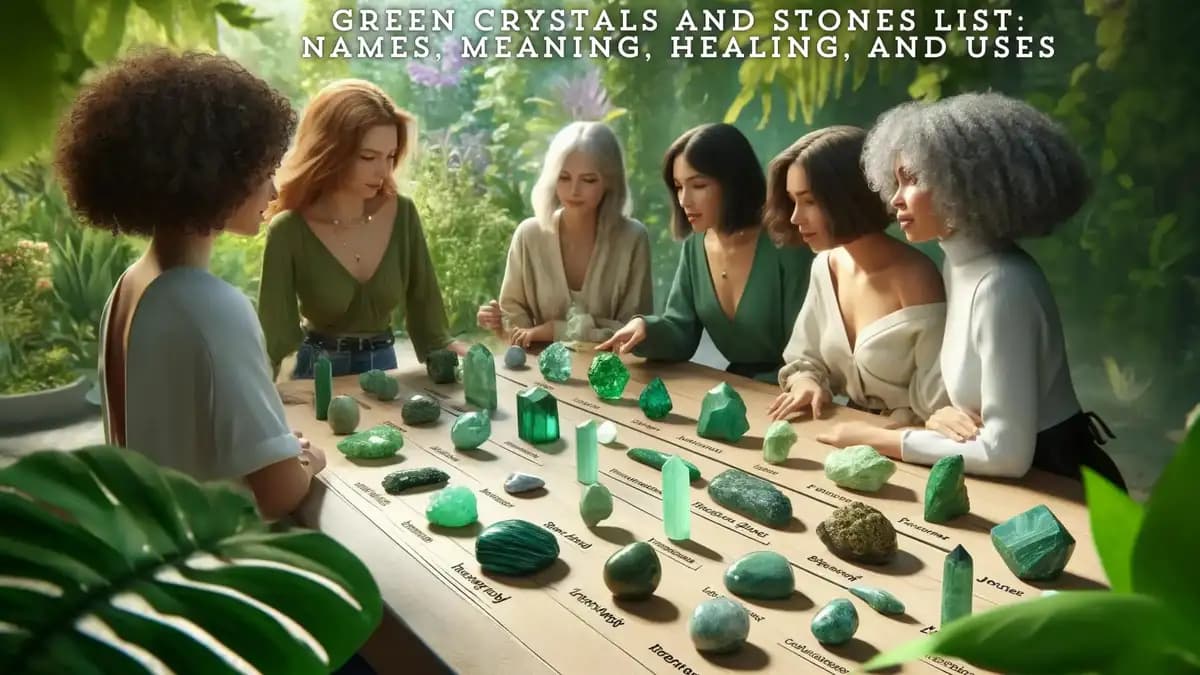
Green Crystals and Stones: Names, Meanings, and How to Identify Them
Green crystals are stones coloured by trace elements such as chromium, iron, nickel, vanadium or copper. The most common ones you will actually encounter are aventurine, malachite, amazonite, moss agate, jade, peridot and green fluorite. In crystal traditions, green is the colour associated with the heart centre, growth, renewal and prosperity, which is why green stones dominate collections built around calm and emotional balance.
If you are holding a green stone right now and want to know what it is, start with the identification table below. If you want the meanings, keep scrolling the guide is organised by shade, from palest mint to deepest forest green, because shade is the fastest way to narrow down an unknown stone.
identification table
Find your stone's shade, then check the giveaway column. Hardness is on the Mohs scale, where a steel knife is about 5.5 and quartz is 7.
Stone | Shade | Mohs | The giveaway |
Aventurine | Light to mid green | 7 | Internal glitter from mica flakes |
Amazonite | Mint to blue-green | 6–6.5 | White criss-cross streaks, silky sheen |
Prehnite | Pale yellow-green | 6–6.5 | Translucent, bubbly "grape" surface |
Variscite | Mint green | 3.5–4.5 | Dark web-like veining, looks like green turquoise |
Green fluorite | Clear to mint | 4 | Glassy, cube-shaped, scratches easily |
Green calcite | Pale waxy green | 3 | Very soft, fizzes in vinegar |
Chrysoprase | Apple green | 6.5–7 | Even colour, no banding, waxy glow |
Serpentine | Yellow-green | 2.5–5.5 | Greasy feel, soft, often sold as "new jade" |
Moss agate | Clear with green | 6.5–7 | Green branching "moss" inside clear stone |
Peridot | Olive to lime | 6.5–7 | Oily lustre, doubled edges when you look through it |
Jade | Mid to deep green | 6–7 | Extremely tough, cold to touch, dense in the hand |
Unakite | Green with pink | 6–7 | Salmon pink patches in green |
Bloodstone | Dark green | 6.5–7 | Red spots on opaque dark green |
Malachite | Light and dark green | 3.5–4 | Concentric bands and bullseye rings |
Seraphinite | Near-black green | 2–2.5 | Silvery feather patterns |
Emerald | Vivid green | 7.5–8 | Included, glassy, valuable |
Light green crystals
Light green crystals are the most commonly misidentified group, because pale green quartz, feldspar, mica and phosphate minerals all look alike at a glance. These are the names people are usually looking for.
Green aventurine
Colour: pale to medium green, sometimes with a silvery shimmer Mineral: quartz with fuchsite mica inclusions Hardness: 7 Found in: India, Brazil, Russia
Aventurine is the stone most often mistaken for jade in tumbled form. The difference is visible: tilt aventurine under a lamp and you will see tiny flat flecks catching the light, an effect called aventurescence. Jade has no glitter. Aventurine is also lighter in the hand and slightly less dense.
In crystal work, aventurine is the stone most associated with luck, opportunity and new ventures, and it is commonly carried during job hunts or business launches. Practitioners describe it as a heart-centre stone used for optimism rather than intensity.
Amazonite
Colour: mint green to turquoise blue-green Mineral: microcline feldspar Hardness: 6–6.5 Found in: Colorado (USA), Madagascar, Russia, Brazil
Amazonite is unmistakable once you know the marker: it carries pale white streaks running through it in a criss-cross grid, a texture caused by intergrown feldspar. It also has a soft, almost silky sheen rather than a glassy one. Despite the name, it was never found on the Amazon.
Amazonite is traditionally called the stone of honest speech, sitting between the heart and throat, and it is used in practice for clear communication and setting boundaries.
Prehnite
Colour: pale yellow-green to lime Mineral: calcium aluminium silicate Hardness: 6–6.5 Found in: Mali, Australia, China, South Africa
Prehnite has a distinctive translucent, almost gelatinous look, which is why raw clusters are nicknamed grape jade. It frequently grows with black or dark green epidote needles trapped inside, a combination collectors specifically look for.
Prehnite is used in crystal traditions for releasing what you no longer need, and it is often paired with journalling or decluttering practices rather than worn as jewellery.
Green fluorite
Colour: clear pale green to deep sea green Mineral: calcium fluoride Hardness: 4 Found in: China, Mexico, England (Weardale), Spain
Fluorite forms natural cubes and octahedrons with perfect flat faces, which makes it easy to identify. It is glassy, often colour-zoned in bands, and many specimens glow blue under UV light the word fluorescence is named after this mineral. At hardness 4 it scratches with a nail file, so it is a display stone rather than a ring stone.
Green fluorite is associated with mental clarity and focus, and it is one of the most common stones on study desks and work surfaces.
Variscite
Colour: mint to apple green with dark veining Mineral: hydrated aluminium phosphate Hardness: 3.5–4.5 Found in: Utah and Nevada (USA), Australia, Germany
Variscite looks like green turquoise and is regularly sold as such. The web-like matrix pattern is the tell, along with the colour, which sits closer to spring green than blue. It is a genuinely uncommon stone and worth checking twice if it is priced cheaply.
Green calcite
Colour: pale mint, waxy Mineral: calcium carbonate Hardness: 3 Found in: Mexico, Brazil, USA
Green calcite is very soft, breaks into rhombus-shaped pieces along its cleavage planes, and fizzes if a drop of vinegar touches it. That fizz test is definitive and takes two seconds. Keep it dry and away from other stones, as almost everything scratches it.
Mid green and apple green crystals
Chrysoprase
Colour: apple green to deep grass green Mineral: chalcedony coloured by nickel Hardness: 6.5–7 Found in: Queensland (Australia), Poland, Tanzania
Chrysoprase is the finest of the green chalcedonies and the most valuable non-transparent green stone after jade. It has an even, glowing colour with no banding and a slightly waxy surface. One practical warning: chrysoprase can fade with prolonged sun exposure or heat, so it should not be left on a windowsill.
It is traditionally associated with emotional healing after loss and is used for grief work and self-forgiveness in crystal practice.
Moss agate
Colour: colourless to milky, with green inclusions Mineral: chalcedony with chlorite or hornblende inclusions Hardness: 6.5–7 Found in: India, USA, Brazil
Moss agate is not a true agate, because it lacks the concentric banding that defines agates. What you are seeing is a translucent stone with green mineral growths branching through it like plant matter. No two are alike, which is most of the appeal.
It is known in crystal traditions as the gardener's stone and is linked to slow growth, new beginnings and abundance.
Jade: jadeite and nephrite
Colour: pale to deep green, occasionally near-emerald Mineral: two distinct minerals jadeite (pyroxene) and nephrite (amphibole) Hardness: 6.5–7 jadeite, 6–6.5 nephrite Found in: Myanmar, Guatemala, Russia (jadeite); China, Canada, New Zealand, Russia (nephrite)
Jade is not one mineral. Jadeite is rarer and produces the intensely saturated imperial green prized in Asian markets. Nephrite is more common, slightly softer, but exceptionally tough due to its interlocking fibrous structure jade is among the hardest natural materials to break, which is why it was used for axe heads and tools long before it was used for jewellery.
Real jade feels distinctly cold and heavy for its size. Fakes are widespread: dyed quartz, dyed serpentine and treated jade sold as untreated. If jade matters to you and the price is significant, buy from a dealer who supplies a lab report.
Jade carries thousands of years of cultural meaning in China and Mesoamerica, associated with virtue, harmony, protection and longevity. It remains one of the most gifted stones in the world.
Serpentine, sold as "new jade"
Colour: yellow-green to olive, often mottled Mineral: serpentine group Hardness: 2.5–5.5 Found in: China, Afghanistan, Italy, USA
Serpentine has a greasy, soapy feel and is much softer than jade, which is the quickest way to separate the two. It is frequently marketed as new jade, olive jade or Korean jade none of which are jade.
An important note: some serpentine varieties contain chrysotile, a fibrous form that is an asbestos mineral. Polished, sealed pieces are considered safe to handle, but raw serpentine should never be cut, sanded or drilled without proper dust control.
Peridot
Colour: olive, lime, bottle green Mineral: gem-quality olivine Hardness: 6.5–7 Found in: Arizona (USA), Pakistan, Myanmar, Egypt
Peridot is one of the few gems that occurs in only one colour. It has an oily, slightly greasy lustre and strong double refraction look through a faceted stone at the back facets and you will see edges appear doubled. Peridot also arrives from space: it is found in pallasite meteorites and in Hawaii's green sand beaches.
It is the August birthstone and has been mined for over 3,500 years, originally from Zabargad Island in the Red Sea. In crystal work it is associated with releasing envy and resentment.
Unakite
Colour: green with salmon-pink patches Mineral: altered granite of epidote, pink feldspar and quartz Hardness: 6–7 Found in: Unaka Mountains (USA), South Africa, Brazil
Unakite is instantly recognisable because of the pink. It is a rock rather than a single mineral, which is why the pattern is blotchy rather than banded. It is inexpensive, durable and common in tumbled sets. Traditionally it is used as a stone of balance and gentle emotional recovery.
Dark green crystals
Malachite
Colour: light and dark green, always banded Mineral: copper carbonate hydroxide Hardness: 3.5–4 Found in: Democratic Republic of the Congo, Zambia, Russia, Australia
Malachite is the most visually distinctive green stone there is: concentric bands, bullseye rings and swirls in alternating light and dark green. The pattern comes from its formation in layers around copper deposits. Nothing else looks like it.
Two safety points, because they matter. Malachite is a copper mineral and its dust is toxic if inhaled, so it should never be dry-cut, sanded or drilled at home. It should also never be soaked to make drinking water or "gem elixirs." Handling a polished, sealed piece is safe.
Malachite is traditionally called a stone of transformation and protection, and it is strongly associated with the heart centre in European and African stone traditions alike.
Bloodstone (heliotrope)
Colour: dark green with red flecks Mineral: chalcedony with iron oxide inclusions Hardness: 6.5–7 Found in: India, Brazil, Australia
Bloodstone is opaque dark green scattered with red spots, which medieval tradition connected to blood and to endurance. It is durable, inexpensive and commonly carried as a courage or stamina stone. It is an alternative March birthstone.
Seraphinite
Colour: deep green to near-black with silver feathering Mineral: clinochlore Hardness: 2–2.5 Found in: the Lake Baikal region of Siberia, Russia and essentially nowhere else
Seraphinite is one of the few stones that is genuinely single-source. The silvery, feather-like chatoyant patterns running through the dark green give it its name, after the seraphim. It is extremely soft, so it is sold polished as cabochons and should be kept away from harder stones.
Chrome diopside
Colour: vivid deep forest green Mineral: calcium magnesium silicate Hardness: 5.5–6 Found in: Siberia (Russia), Pakistan, Myanmar
Chrome diopside offers emerald-like colour saturation at a fraction of emerald's price. The trade-off is hardness: at 5.5–6 it is too soft for a daily-wear ring and is better suited to pendants and earrings. Stones above about two carats tend to darken to near-black.
Epidote
Colour: pistachio to dark olive green Mineral: calcium aluminium iron silicate Hardness: 6–7 Found in: Austria, Pakistan, Mali, Norway
Epidote's yellow-green pistachio tone is unusual enough to be a marker in itself. It commonly forms alongside prehnite and quartz, and specimens combining all three are popular with collectors. In crystal practice it has a reputation for amplifying whatever is already present, which is why it is often recommended alongside intention-setting rather than on its own.
Sage green, olive green and grey-green stones
These muted shades trip people up most often. Sage and olive tones usually point to one of four stones: serpentine, epidote, olive jade (also serpentine), or fuchsite.
Fuchsite is a chromium-rich muscovite mica, soft at around 2–3, and unmistakably sparkly with a flaky, layered structure that can be picked apart with a fingernail. It is the same mineral that gives green aventurine its glitter. Fuchsite is often found with ruby, sold as ruby fuchsite.
Verdite is a mottled deep sage-to-olive rock from Zimbabwe and South Africa, soft enough to carve, and frequently used for sculpture.
Green jasper covers a range of muted olive and grey-greens, always opaque, always fine-grained, and usually inexpensive.
Rare and precious green gemstones
These are the stones your search results will surface but that almost nobody actually owns. They are included for completeness.
Emerald
The definitive green gemstone: beryl coloured by chromium or vanadium, hardness 7.5–8, and the May birthstone. Colombian material from the Muzo and Chivor mines sets the standard, with major production also from Zambia and Brazil.
Emerald is hard but brittle, because nearly every stone contains internal fractures and inclusions, known in the trade as the jardin, or garden. Well over 90% of emeralds on the market are treated with oil or resin to reduce the visibility of those fractures this is a normal, disclosed industry practice, but it means emeralds should never be cleaned in an ultrasonic machine.
Historically emerald has been tied to truth, foresight and loyalty, and it remains one of the four traditional precious gemstones alongside diamond, ruby and sapphire.
Green tourmaline (verdelite)
Hardness: 7–7.5, found in Brazil, Afghanistan, Nigeria and Mozambique. Green tourmaline is strongly pleochroic, meaning it shows different depths of colour depending on the viewing angle. Chrome tourmaline, coloured by chromium and vanadium, reaches the most intense emerald-like green. It is an October birthstone and is durable enough for everyday jewellery.
In crystal work, green tourmaline is one of the most frequently recommended stones for calm and grounding.
Green garnets: tsavorite, demantoid and uvarovite
Garnet is a mineral family, not a single stone, and several members are green.
Tsavorite is a grossular garnet discovered in 1967 near the Kenya–Tanzania border and named after Tsavo National Park. Hardness 7–7.5, vivid green, and rarer than emerald in fine sizes.
Demantoid is an andradite garnet with dispersion higher than diamond's, meaning it throws exceptional fire. Russian Ural material is the most prized and often contains distinctive "horsetail" fibre inclusions that actually increase its value.
Uvarovite is the brilliant emerald-green garnet that occurs as tiny druzy crystal crusts rather than cuttable stones, mostly from Russia and Finland.
Alexandrite
Colour-change chrysoberyl, hardness 8.5, and the rarest gem on this list by a wide margin. It appears green in daylight and shifts to red or purplish-red under incandescent light, a phenomenon caused by chromium and the specific way the stone absorbs light. Originally from Russia's Ural Mountains, with modern material from Brazil, Sri Lanka and Tanzania.
Be aware that the overwhelming majority of alexandrite sold online is either lab-created or colour-change sapphire and spinel misrepresented as alexandrite. Natural alexandrite over one carat commands prices comparable to fine ruby.
Green diamond
Natural green diamonds get their colour from millions of years of exposure to natural radiation in the surrounding rock, which alters the crystal lattice at the surface. They are exceptionally rare the 41-carat Dresden Green in Germany is the best-known example. Most green diamonds offered commercially have been colour-treated, and this must be disclosed. Any green diamond of significance should carry a report from a recognised laboratory confirming whether the colour is natural.
Serendibite and other collector rarities
Serendibite is among the rarest minerals on Earth, named after Serendib, an old name for Sri Lanka. Faceted gem-quality material exists in single-digit quantities worldwide and most specimens are so dark they read as near-black rather than green. It is a mineralogical curiosity rather than something you will find for sale.
Green stones that are not what they seem
A short list worth knowing before you buy.
Green goldstone, sometimes sold as green sandstone, is man-made glass with copper or chromium particles suspended in it. It is attractive and inexpensive, but it is not a natural stone and should not be sold as one.
Most "green obsidian" on the market is manufactured glass. Natural obsidian is almost always black, brown or grey; genuinely green natural obsidian is rare.
Moldavite is a genuine tektite formed roughly 15 million years ago by a meteorite impact in what is now the Czech Republic, and it is one of the most heavily counterfeited materials sold today. Real moldavite has a distinctive etched, wrinkled surface and internal bubbles. Bright, glossy, uniformly green "moldavite" at a low price is bottle glass.
Dyed green agate and dyed howlite are extremely common in cheap jewellery. Dyed stones often show concentrated colour along cracks, and the colour looks flat rather than layered.
Prasiolite, or green amethyst, is almost always heat-treated amethyst rather than naturally green quartz. This is legitimate as long as it is disclosed.
How to identify an unknown green stone?
Work through these in order. Four checks will usually get you there.
Look for glitter. Internal metallic flecks point to aventurine or fuchsite. Nothing else in the common green group sparkles from within.
Check the pattern. Concentric bands mean malachite. Red spots mean bloodstone. Pink patches mean unakite. Branching green inclusions mean moss agate. White criss-cross streaks mean amazonite.
Test the hardness. A steel blade scratches at about 5.5. If your stone scratches easily it is calcite, fluorite, serpentine, fuchsite or seraphinite. If it resists, you are in quartz-family or jade territory.
Weigh it in your hand. Jade is noticeably dense and stays cold longer than glass or quartz. Glass warms quickly.
Safe handling and care
Most green stones are entirely safe to own and handle. A few require sensible precautions.
Never make drinking water or elixirs by soaking stones
This applies especially to copper minerals like malachite and chrysocolla, which are toxic if ingested. If you want stone-infused water, use the indirect method, where the stone sits outside a sealed container of water and never touches it.
Never dry-cut, grind or sand stones at home, particularly malachite and raw serpentine. Dust is the hazard, not the stone.
Keep soft stones dry
Calcite, malachite, seraphinite and fluorite are damaged by prolonged water contact. Wipe them with a dry or barely damp cloth.
Keep colour-sensitive stones out of direct sun
Chrysoprase, fluorite, prasiolite and some amethyst-derived stones fade with sustained UV exposure. This makes the common advice to "charge crystals in sunlight" actively harmful for these particular stones use moonlight, or simply keep them somewhere dark.
Avoid salt on porous or soft stones
Salt water pits malachite and dulls serpentine.
Green crystals are used as a complement to wellbeing practices, not a substitute for medical care. Nothing on this page is medical advice, and any persistent physical or emotional health concern should be discussed with a qualified professional.
Frequently asked questions
What is the most common green stone?
Green aventurine is the most widely available and most frequently sold green crystal, followed by malachite, amazonite and moss agate. If you own a tumbled green stone from a general shop, aventurine is the most likely answer.
What is the light green crystal called?
The most likely candidates are prehnite (pale yellow-green and translucent), amazonite (mint with white streaking), green fluorite (glassy and cube-forming), variscite (mint with dark webbing) or green calcite (waxy and very soft). Use the hardness test to narrow it down.
What do green crystals mean?
Across crystal traditions, green is linked to the heart centre and carries associations of growth, renewal, prosperity and emotional balance. Individual stones carry more specific traditional meanings aventurine with luck and opportunity, malachite with transformation, amazonite with honest communication.
Which green crystal is best for beginners?
Green aventurine. It is inexpensive, durable at hardness 7, safe to handle, resistant to water and sunlight, and easy to find. Moss agate and amazonite are equally forgiving starting points.
What is the green and white crystal called?
Most likely amazonite, which naturally shows white feldspar streaking through mint green. Other possibilities are moss agate (green inclusions in a milky base) or ocean jasper.
Is green jade the same as green aventurine?
No. They are different minerals and are commonly confused. Aventurine sparkles internally from mica flakes and is lighter in the hand; jade has no glitter, feels denser and colder, and is far tougher. Aventurine is also considerably less expensive.
What is the rarest green gemstone?
Among gemstones you might realistically encounter, natural alexandrite and fine demantoid garnet are the rarest. Among minerals generally, serendibite and gem-quality green diamond are rarer still, with only a handful of significant examples known.
Are any green crystals dangerous?
Malachite dust is toxic and raw serpentine can contain asbestiform fibres, so neither should be cut or sanded without proper equipment. Polished, sealed specimens are safe to handle and display. No green crystal should be soaked to make drinking water.
In summary
If you want a green crystal and are not sure where to start, aventurine, moss agate and amazonite are the three most practical choices affordable, durable, easy to identify and safe to handle. If you are trying to identify a stone you already own, shade plus a hardness test will get you to an answer faster than anything else.
Green stones have been valued across cultures for thousands of years, from Chinese nephrite carvings to Egyptian peridot to Colombian emerald. Whatever meaning you attach to them, they are also a genuinely interesting corner of mineralogy and knowing what you are actually holding makes owning one considerably more rewarding.
Shop This Category
Carabiner Lock
Wholesale Custom Jewelry Manufacturers
Maroth Jewels is a leading manufacturer specializing in 92.5 Sterling Silver, 14K/18K Gold, and Gemstones jewelry. We support designers and retail brands worldwide.
Request Bulk QuoteLooking for more articles?
Browse all blogs