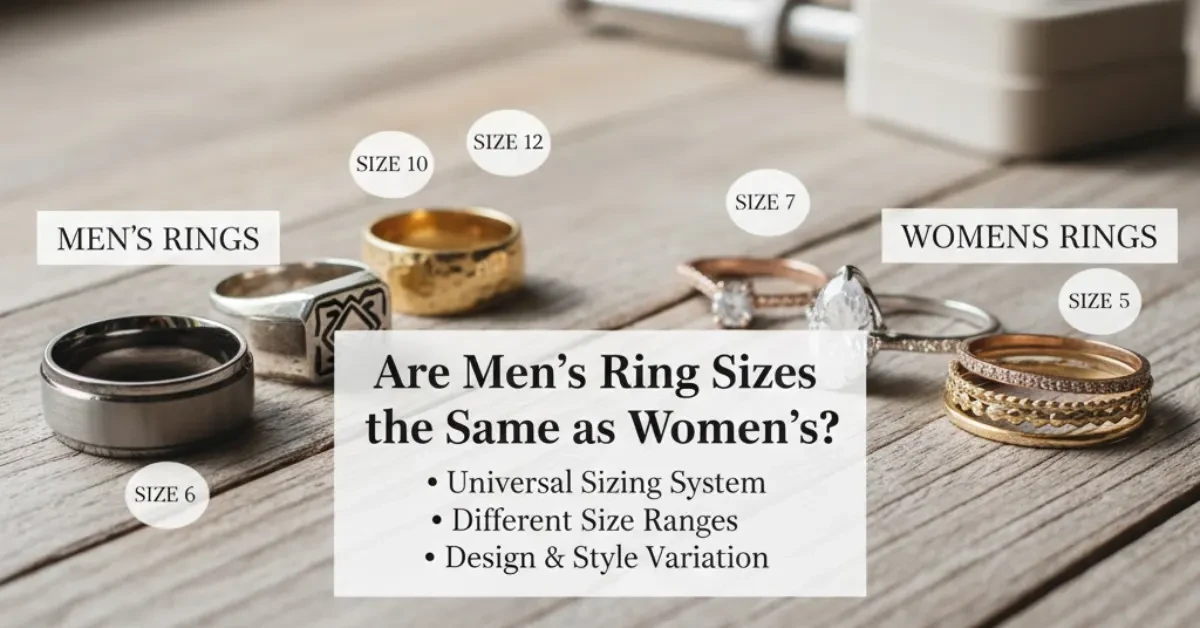
Are Men’s Ring Sizes the Same as Women’s?
When people shop for rings whether for weddings, engagements, gifts, or personal style. One of the first questions that comes up is simple but important: Are men’s ring sizes the same as women’s?
At first glance, ring sizing seems universal because the measurement systems used by jewelers appear to follow a single scale. But the truth is a bit more complex. While the numeric sizing system is technically the same for both men and women.
But how jewelers design, measure, and structure rings often results in meaningful differences that shoppers need to understand. At Maroth Jewels, we see this confusion often, especially from buyers purchasing rings online without trying them on in person. This guide dives deeply into what differs between men’s and women’s rings, and how to make sure you always order the right fit.
Understanding ring sizing is not simply about knowing a number. It is about understanding finger structure, lifestyle habits, design elements, and band widths all of which influence how a ring actually feels on the hand.
Choosing the correct size ensures comfort, prevents the ring from slipping, and preserves the wearer’s experience long-term. Whether you're a jeweler, a shopper, or simply someone curious about how sizing works, this guide aims to eliminate confusion and give you complete clarity.
Do Men and Women Use the Same Numeric Ring Sizes?
The short, technical answer is yes. Most countries including the United States, India, Canada, and many others. Use the same numeric ring size chart for every customer, regardless of gender.
A size 7 means the same inner diameter whether the ring is made for a man or a woman. The measuring tools that jewelers use the ring mandrel and ring sizer set are also gender-neutral.
So in terms of pure measurement, there is no separate “men’s scale” and “women’s scale.”
What confuses people is that men and women typically fall into different size ranges. Women usually wear ring sizes between 5 and 8, while men more commonly wear between 8 and 12.
These ranges are not strict but they form typical patterns based on physiological differences in bone structure and hand shape. This gives the impression that men and women use different sizing systems, when in reality, they operate on the same foundation.
Still, using the same numeric system does not guarantee identical fit. Two rings with the same number can feel completely different depending on their width, shape, and design. This is why one person may be comfortable in a size 7 for a thin band but find that the same size feels tight in a wider band.
Why the Same Size May Fit Differently for Men and Women?
If the sizing system is technically identical, why do men’s and women’s rings often feel different on the finger? The answer lies in design and hand structure.
Women generally have narrower fingers, softer knuckles, and slimmer hands, which makes narrower and lighter rings more suitable. Men often have broader fingers, stronger knuckles, and denser bone structure, which means they tend to prefer thicker, sturdier designs.
When a ring is wider, it covers more surface area and naturally feels tighter, even if the numeric size remains unchanged. Women’s rings commonly feature delicate profiles, slimmer bands, and gemstone settings that sit higher on the finger. These styles generally slide onto the finger more easily.
Men’s rings often have flat or comfort-fit interiors, thicker bands, and broader designs that create a snugger, more grounded fit. All of this affects how the ring behaves on the hand. Every finger is shaped differently too. A person might have slim fingers with wide knuckles, making it harder to slide rings on unless the band accommodates that structure.
Even when two individuals wear the same ring size, the feeling may be entirely different depending on these small but important anatomical differences.
How Band Width Changes the Feeling of the Same Ring Size?
One of the biggest misunderstandings in ring sizing is how strongly band width influences comfort. This factor is especially important when comparing men's and women’s rings. Most women’s rings range from 1.5 mm to 3 mm in width.
Men’s rings usually range between 5 mm and 8 mm, and sometimes even wider for modern fashion rings. When a ring is wide, it wraps around more skin, creating greater friction and requiring slightly more space to sit comfortably on the finger.
This is why jewelers often recommend going up half a size when choosing a ring with a very wide band. Even though the ring's inner diameter remains technically consistent, the finger perceives the fit differently.
A narrow band feels loose and easy to slide over the knuckle, while a wide band feels more secure and sometimes slightly tight. Many men prefer heavier bands, so they frequently experience this difference firsthand.
Physical Differences Between Men’s and Women’s Hands
Hand anatomy contributes significantly to sizing patterns. Men generally have larger knuckles. Making the entry point for the ring more challenging but the base of the finger sometimes smaller in proportion. Women often have the opposite smaller knuckles but a slightly more flexible and soft base area. These differences influence how the ring slides and how it settles when worn.
Temperature and daily activities also impact how the finger expands or contracts. Someone with a physically active lifestyle might require a slightly looser ring so that swelling during activity does not cause discomfort.
Men often engage in activities that create temporary hand swelling, such as workouts, heavy lifting, outdoor tasks, or sports. Women may experience hand swelling due to hormonal changes or temperature shifts.
Even identical sizes can feel entirely different because of how the ring interacts with each unique hand structure.
Design Style and Fit Expectations
Because men and women often prefer different styles. Rings are built with different weight, thickness, and silhouettes. Men’s rings tend to sit flatter and bulkier on the hand. Making them more noticeable in how they fit. Women's rings usually focus on elegance and fluidity, often using lighter metals, slimmer bands, and intricate stone settings that don’t create as much pressure on the finger.
Even gemstone rings vary between genders. A solitaire engagement ring has a different weight distribution compared to a solid metal band. Heavy metal rings create firmer contact with the skin whereas stone-centered rings distribute weight in a more balanced way. All of this affects how snug or loose a ring feels.
When comparing sizes between men’s and women’s rings. You cannot rely on the number alone. You must consider how the design interacts with the finger: weight, balance, thickness, height, and curvature all play roles. The same size can feel perfect in one design and uncomfortable in another simply due to structural differences.
Measuring Ring Size Correctly for Both Men and Women
Accurate measurement is the key to the perfect fit, regardless of gender. Many people mistakenly measure their fingers at the wrong time of day, when they are too cold or too warm.
This leads to inaccurate sizing, especially for men, who tend to experience more variation in finger expansion due to thicker skin and more frequent engagement in physical activity. Women may experience swelling related to hormonal cycles or temperature shifts throughout the month.
The ideal time to size your fingers is when your hands are at a normal, relaxed temperature not right after waking, after exercise, or during extreme weather. Using a proper jeweler’s ring sizer gives the most accurate results. Measuring at home with a string is an option, but it can easily produce inconsistencies because soft materials stretch and do not reflect the inner shape of an actual ring.
For men, it may be wise to size up slightly if the ring is thick or heavy. For women choosing slim, delicate designs, the exact measured size is usually perfect. If measuring for a gift, using an existing ring from the same finger is the safest method, but only if the ring width matches the new ring’s width.
Are Unisex Ring Sizes Any Different?
Many modern jewelry collections, especially in handmade or luxury categories, include unisex rings that are designed for all genders. These rings follow the same sizing chart but are usually built to balance comfort across different hand structures.
Unisex sizing works best when rings are simple, minimalistic, and evenly distributed in weight. More elaborate rings with stones, engravings, or asymmetrical shapes behave differently on each wearer and may require personalized sizing adjustments. So while unisex rings can offer a flexible option, they do not eliminate the need for accurate sizing.
Common Myths About Men’s and Women’s Ring Sizes
A frequent misconception is that men's rings run bigger or women’s rings run smaller as part of a special sizing system. This is incorrect. The sizing scale remains universal.
Another myth is that the engagement or wedding finger always matches the size of other fingers. Every finger is different; even the same finger on the dominant hand can differ from the non-dominant hand.
People also assume that rings of the same size will always fit the same, but as we’ve established, design plays an enormous role. Another myth is that resizing is risky or will affect the quality of the ring.
So, Are Men’s and Women’s Ring Sizes the Same? Final Answer
Yes, men’s and women’s ring sizes follow the same numerical system. But the fit is not always identical due to differences in design, band width, hand anatomy, and preferred style. A size 8 is always a size 8 in measurement terms. But it can feel different on a man’s hand versus a woman’s hand depending on how the ring is constructed.
When shopping for rings especially online consider the ring’s width, weight, style, and interior shape. Measure your finger accurately, and don’t hesitate to adjust the size slightly if the design calls for it.
At Maroth Jewels, we prioritize fit and comfort as much as aesthetics, because a ring is not only a piece of jewelry. It is something you wear daily, something that should feel like a natural extension of your hand.
Men's Ring Size Guide: Finding the Perfect Fit
Find Out Your Ring Size
Acquiring a ring is a major choice that deserves a degree of serious thought. Getting the right size is vital, so it’s important to have your measurement before making a purchase. An incorrect ring size can be fairly disappointing. Getting the size right is crucial. This topic includes all aspects of deciding your men's ring size. Are you just maybe taking a look at rings designed for men. To learn your men's ring size, you need to measure the circumference of your finger and look it up on the Men's Ring Size Chart .
RING SIZE GUIDELINES CHART
INTERNAL Diameter (mm) | UK | US | EU | CHINA |
14.5 | G | 3.75 | 45 | 6 |
14.8 | H | 4.25 | 46.5 | 7 |
15.2 | I | 4.5 | 47.5 | 8 |
15.6 | J | 5 | 48.5 | 9 |
16.0 | K | 5.5 | 50 | 10 |
16.4 | L | 6 | 51 | 11 |
16.8 | M | 6.5 | 52.5 | 12 |
17.2 | N | 6.75 | 53.5 | 13 |
17.4 | O | 7 | 55 | 14 |
18.0 | P | 7.5 | 56 | 15 |
18.4 | Q | 8 | 57.5 | 16 |
19.0 | R | 8.5 | 59 | 17 |
19.2 | S | 9 | 60.25 | 19 |
19.5 | T | 9.5 | 62.75 | 19 |
20 | U | 10 | 63 | 21 |
20.3 | V | 10.5 | 64 | 23 |
20.7 | W | 11 | 65 | 22 |
21.1 | X | 11.5 | 66.5 | 23 |
21.4 | Y | 12 | 67.5 | 24 |
21.8 | Z | 12.5 | 69 | 25 |
VISIT FOR :: jewelry manufacturers
How can you Find the Perfect Fit?
To assess the length of your finger, you should have available to you a flexible tape measure, a strip of paper, or some string.
You can get the same result by bandaging the tape/paper/string around the base of your finger, mimicking a conventional ring fit – be sure to notice where it ends.
Use a ruler or any inch tape and then mark it in millimeters to find out the exact specifications of the paper or string as per your finger.
Refer to the Men’s Ring Size Chart provided (if, for example, your finger measures 17.75 mm, your ring size is P)
Now whatever the exact fit you feel , you can say this is your ring size
Other Basic Techniques to Find out the Men Size
This is an incredible technique for understanding men’s ring size.
Get your Ring Size by having an old ring you can use for an exact size.
As an unwritten rule, one should buy a comfort fit ring of a size that is about a half size smaller than their standard fit ring size. All sizing done from this page is taken to represent standard ring sizes, not comfort fit.
Usually, the variation is between 8 and 14. Sizes 8 to 12 are the most often selected purchases. The average for men is 10. No, shoe size and ring size are not alike.
Ring Sizers: The Professional Approach
Measurement devices known as professional ring sizers are more accurate and can take the form of either measuring tapes or keyrings that show size indicators. Lay one end of the ring sizer through the buckle. Set up a curved shape with the opposite end. Afterward, pull the sizer across the preferred finger and buckle it up.
If it's unclear how big the ring is, it’s best to size up.
To achieve the accuracy, choose any expert or friends, measure twice, or you can check the weather and choose day time to measure. Millimeter sizing will give the exact size difference.
Typically, standard ring sizes will increase by 0.4 millimeters for every half-size, and a difference of 2.61 millimeters will give rise to a complete size difference.
As fingers tend to shrink or swell with changes in temperature, those fluctuations can play a role in ring size. Also, the evening might find fingers bigger because they are retaining water and are less hydrated than they are during the morning. Always make sure your ring is little movable and can come out with little force and can feel comfortable and fit at any time.
It may be that you are already the fortunate owner of a ring that fits your needs perfectly. Even when you aren't sure about the size. We must measure the diameter in millimeters. You will eventually find out your ring size by referring to the men’s ring sizer chart that follows.
VISIT FOR :: 9 carat gold
Several alternative methods exist for measuring ring size at home:
Online apps: Certain phone applications are able to take you through a methodical process that helps you figure out your ring size.
Printable charts: A plethora of websites gives their visitors access to printable sizing charts. Making them complete at 100% scale allows you to use these printouts to measure either your ring or your finger.
Factors Beyond Ring Size
When selecting the perfect ring band, several elements besides the basic ring size come into play:
Hand Shape: Enlarging the size slightly helps those with bigger knuckles find a comfortable fit, but they still need a close fit around the foundation of their finger.
Band Width: In most situations, more intimate bands are less cautiously tightened than their comprehensive counterparts. A number of men recognize that a wider band is necessary, usually beginning at the next half size up.
Style Preference: The whole design of the ring, from aesthetic to how it feels, has an influence on its comfort and how it looks. The performance of diverse writing methods might change according to the size and shape of the hand.
Conclusion
It is important to find a men’s ring that checks both style and comfort boxes. Data on sizing that is correct helps to guarantee the ring appears great and is comfortable to wear. Apply the home measuring techniques and tidbits with confidence to find out your ring size.
You should remember how you want the ring to feel comfortable in your hand, thinking about what you personally enjoy. Should you want to keep your size decision or look for additional assistance, engaging with an experienced jeweler is important.
READ MORE :: How to Measure Your Ring Size at Home?
Shop This Category
Carabiner Lock
Wholesale Custom Jewelry Manufacturers
Maroth Jewels is a leading manufacturer specializing in 92.5 Sterling Silver, 14K/18K Gold, and Gemstones jewelry. We support designers and retail brands worldwide.
Request Bulk QuoteLooking for more articles?
Browse all blogsLatest Products
View AllPrivate Lable 14K Yellow Gold Marquise Bloom Ear Jacket Earrings with Marquise CZ Stones Floral Statement Fine Jewelry
Private Lable 925 Silver Yellow Gold Plated Marquise Bloom Ear Jacket Earrings with Marquise CZ Stones Floral Statement Fine Jewelry
14K Yellow Gold CZ Lumera Apple Pendant Elegant Fruit Charm Designer Jewelry Supplier
925 Silver Yellow Gold Plated CZ Lumera Apple Pendant Elegant Fruit Charm Designer Jewelry Supplier
Wholesale 14K Yellow Gold Sylvara Tree Disc Pendant with CZ Minimalist Nature Inspired Circle Charm Handmade Jewelry
Wholesale 925 Silver Yellow Gold Plated Sylvara Tree Disc Pendant with CZ Minimalist Nature Inspired Circle Charm Handmade Jewelry
14K White Gold Minimal Rabbit Nature Inspired Bunny Animal Ring Manufacturer
925 Sterling Silver White Gold Plated Minimal Rabbit Nature Inspired Bunny Animal Ring Manufacturer
14K Yellow Gold Black CZ Velvet Poodle Minimalist Puppy Animal Ring Custom Jewelry
925 Silver Yellow Gold Plated Black CZ Velvet Poodle Minimalist Puppy Animal Ring Custom Jewelry
Contact Us For Custom Jewelry
Please get in touch with us and share your ideas if you have personalized jewelry or are searching for a private label jewelry manufacturer. In accordance with your suggestions, we will make and present genuine jewelry.
B2B Jewelry Manufacturer for Global Brands
Share your design, metal, plating, gemstone, and quantity requirements for a custom manufacturing quotation. We work in sterling silver and solid gold, including precious, semi-precious, lab diamond, and genuine diamond jewelry.
MOQ & Pricing
MOQ usually starts from 5 to 10 pieces depending on design. Sample pricing and quantity-based prices are available.
CAD & Production
CAD usually takes 3 to 4 working days. Sample production takes 25 to 30 days and bulk production takes 30 to 40 days.
Shipping
Shipping: 4 to 7 days worldwide.
Payments
We accept payments via PayPal, Payoneer, Wise, and bank transfer.