Turquoise Crystal Meaning: Properties, Benefits, and Uses Explained
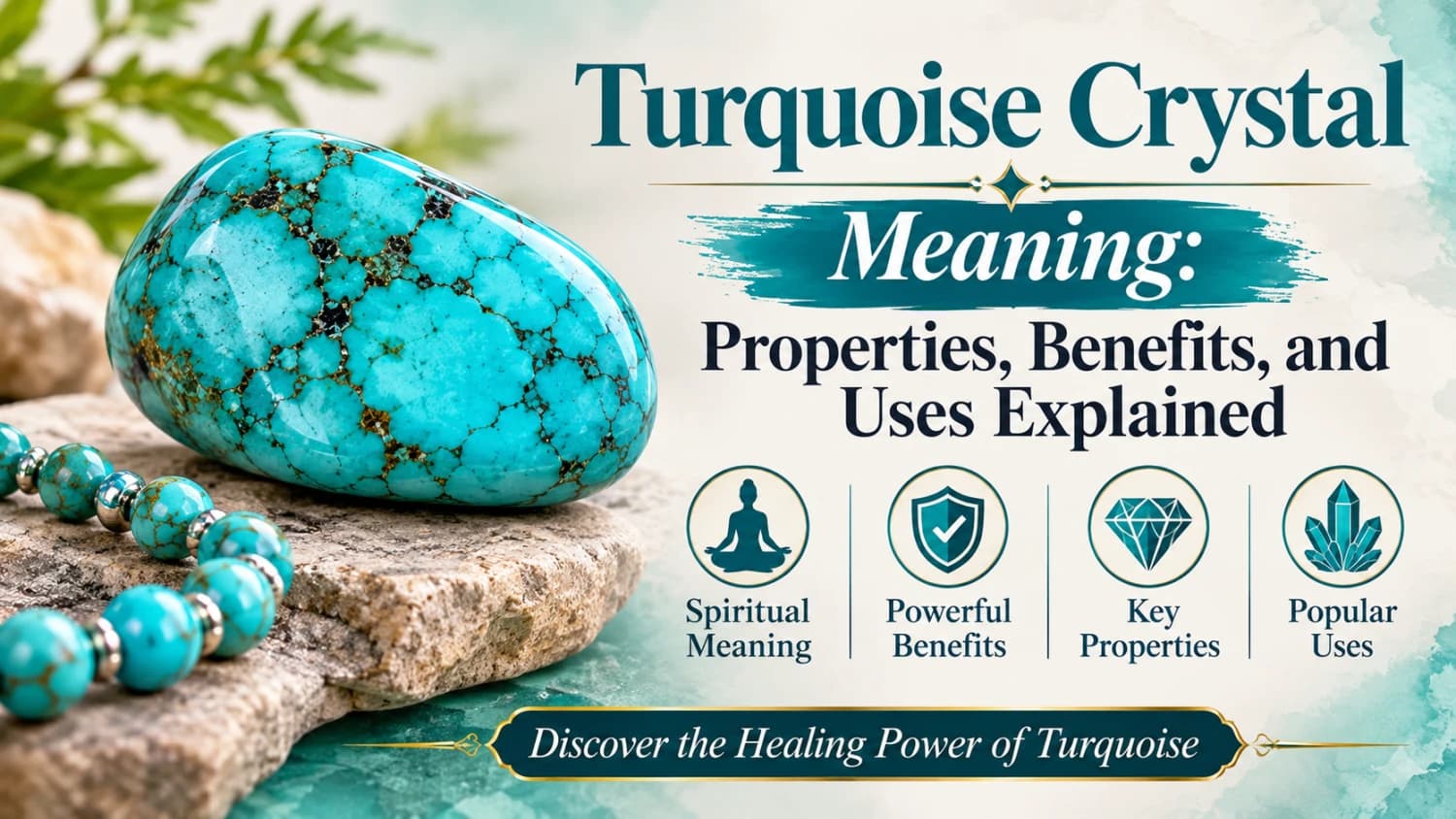
Turquoise Crystal Meaning: Properties, Benefits, and Uses Explained
People have worn turquoise for more than 5,000 years, long before anyone wrote a crystal guide about it. The color was even named after the stone: English speakers were calling things "turquoise" by 1573.
Ask a crystal lover what turquoise means and you'll hear "protection" and "speaking your truth." Ask a gemologist and you'll hear "hydrated copper aluminum phosphate, 5 to 6 on the Mohs scale, usually stabilized." If you want a piece you'll wear for years, both answers matter.
We make gemstone jewelry in 925 sterling silver and 14K gold at our workshop in Jaipur, and turquoise asks for more care at the bench than most stones. This guide covers what turquoise means, where those meanings come from, its real physical properties, how people use it, and how to tell natural turquoise from the dyed look-alikes that flood the market.
Turquoise at a Glance
Here's the short version, with gem facts and crystal traditions labeled separately.
What Is Turquoise?
Turquoise is a copper-bearing mineral that forms only in dry, barren places. it grows where acidic, copper-rich groundwater seeps down through rock and reacts with minerals containing aluminum and phosphorus. That's why the great deposits sit in deserts: Arizona, Nevada, New Mexico, northeastern Iran and the Sinai.
Copper gives turquoise its blue. When iron takes the place of some of the aluminum, the color drifts toward green, so one mine can produce both sky-blue and apple-green stones.
The dark lines in many stones are called matrix. They're leftovers of the host rock: dark brown from iron-rich limonite, tan from sandstone, or fine black seams in what the trade calls spiderweb turquoise. Some buyers avoid matrix entirely, while collectors pay extra for a tight, even web.
Is turquoise actually a crystal?
Not the way quartz is. Turquoise almost never grows crystals you can see; it's a solid mass of microscopic crystals packed together.
That packing decides almost everything. Tightly packed stones are dense, take a waxy polish and wear well. Loosely packed stones are chalky and porous, and they usually get treated before they reach a store.
So "turquoise crystal" is the crystal community's name for the stone, and it's a fair one. Just expect a polished nugget, bead or cabochon, not a pointed crystal.
Turquoise Crystal Meaning
Turquoise means protection, wisdom, good fortune and honest speech. Those meanings weren't invented by a crystal book. At least five cultures arrived at them on their own, which is a big part of why the stone still feels so loaded today.
The core meanings, one line each:
● Protection: riders, travelers, hunters and warriors carried it as a guard against harm.
● Victory and good fortune: the old Persian name, pirouzeh, carries the meaning of victory.
● Truth and communication: modern crystal practice links it to the throat chakra and saying what you mean.
● Wisdom and calm: it's the cool, steady stone people reach for when emotions run hot.
● Sky meets earth: Southwestern traditions tie it to the sky, water and rain.
Ancient Egypt: the lady of turquoise
Egyptians mined turquoise in the southwestern Sinai at Wadi Maghara and Serabit el-Khadim, sending royal expeditions there through the third and second millennia BCE. The goddess Hathor appears in texts as the lady, or mistress, of turquoise, and a temple to her stood at Serabit el-Khadim.
Among the rare early examples are turquoise beads on bracelets found in the tomb of King Djer at Abydos, from Egypt's First Dynasty about 5,000 years ago. Here's a detail most guides skip: turquoise was actually scarce in Egypt, and many "turquoise" inlays from later royal tombs turned out to be glass or faience. Fakes are nearly as old as the stone.
Persia: the stone of victory
In Persian, turquoise was pirouzeh, later firouzeh, a name tied to victory, triumph and prosperity. The mines near Neyshabur (Nishapur) in northeastern Iran have been worked for so long that some shafts date back many centuries.
The trade still calls an even, intense sky blue "Persian blue," whether the stone came from Iran or not. That tells you how long Iran set the standard.
Tibet and the Himalaya
GIA calls turquoise the national gem of Tibet, a stone long trusted for health, good fortune and protection from evil. Tibetans wear it in bold necklaces and headdresses, often beside red coral, and men wear it as readily as women.
Turquoise Meaning by Color
Natural turquoise runs from sky blue through blue-green to green, and each shade carries its own traditional meaning. Anything pink, purple, red or orange has been dyed.
Shade | What causes it | Traditional meaning | Market notes |
Sky or robin's egg blue | Copper, very little iron | Clarity, calm, open communication | The most prized color; the trade calls it "Persian blue" |
Blue-green to green | More iron | Earth, steadiness, growth | Usually priced lower, though some designers seek out avocado and lime greens |
Spiderweb (fine dark web) | Thin seams of host rock | Same as its base color | Second in value only to clean, matrix-free stones |
Pale or chalky | Very porous, low-grade turquoise | Same as its base color | Almost always dyed and stabilized before sale |
"White turquoise" | Usually howlite or magnesite | Not turquoise | Buy it for the look, not the stone |
Red, purple, pink, orange | Dye added to chalky turquoise, howlite or magnesite | Not a natural turquoise color | Fine as fashion jewelry if it's labeled as dyed |
Blue vs. green turquoise: which is "stronger"?
Neither. In crystal practice, blue stones lean toward communication and calm, while green stones lean toward grounding and steady growth.
Value is a different story. An even, intense medium blue usually sells for more than green. Still, pick the shade you'll actually wear.
Is red turquoise real?
No. Natural turquoise never comes in red. "Red turquoise" is dyed material, usually chalky turquoise, magnesite or howlite soaked in color, sometimes pressed into blocks. It can still make fun jewelry, as long as the seller says what it is.
Turquoise Properties
"Properties" means two different things in turquoise guides, so we'll cover both. First come the physical properties a gemologist can measure, then the metaphysical properties crystal practitioners describe.
Physical and gemological properties
Property | Value | What it means when you wear it |
Hardness | 5 to 6 on the Mohs scale | Household dust contains quartz, which is harder, so rings and bracelets slowly scuff |
Toughness | Fair to good; better in fine-textured stones | Coarse, chalky stones chip more easily |
Specific gravity | 2.6 to 2.8 | Natural stone feels heavier in the hand than plastic fakes |
Refractive index | About 1.61 to 1.65 | One of the readings a gemologist uses to rule out look-alikes |
Porosity | Low to high, depending on texture | It soaks up skin oils, lotion and perfume, which can turn blue stones greener |
Heat | Sensitive | High heat can discolor it and damage the surface |
Light | Generally stable | Ordinary daylight isn't the threat; a hot car dashboard is |
Chemicals | Sensitive | Cosmetics, sweat and solvents can discolor it |
Metaphysical properties (crystal tradition)
These correspondences come from modern crystal books and older folklore. They aren't measurable, but they explain how people choose and use the stone.
Correspondence | Turquoise |
Chakra | Throat (Vishuddha); some practitioners also place it at the heart or third eye |
Zodiac | Sagittarius, plus Pisces and Scorpio |
Planets | Venus and Neptune; some astrologers add Jupiter |
Element | Air or storm in crystal guides; water in feng shui |
Keywords | Protection, truth, calm, wholeness, luck, friendship |
Turquoise Benefits
Most of the benefits people describe are emotional and spiritual: calm, confidence when speaking, and a feeling of being protected. Some crystal pages go much further and claim turquoise treats asthma, infections or depression. We won't repeat those claims, because there's no evidence behind them and those are conditions for a doctor.
Emotional benefits (as people describe them)
● Calm under pressure: its cool color and smooth, waxy feel make it a natural worry stone to hold when your thoughts race.
● Steadier moods: crystal practitioners call it a balancing stone, used to take the edge off irritability and overreaction.
● Self-forgiveness: modern crystal writers tie it to letting go of old regrets and being kinder to yourself.
Communication and confidence
This is the benefit most people come to turquoise for. As the throat-chakra stone, it's worn before presentations, interviews, auditions and difficult conversations.
The idea isn't that the stone talks for you. It reminds you to slow down, breathe and say the true thing clearly.
Protection, travel and luck
Protection is turquoise's oldest job. Horsemen, hunters and travelers carried it for centuries, and plenty of people still keep a piece in a carry-on or the car.
It's also the stone of victory in Persian tradition. That makes it a popular good-luck gift for new jobs, exams and fresh starts.
Spiritual growth
In crystal practice, turquoise is a stone of wholeness. People meditate with it to feel grounded and open at the same time, which echoes the Southwestern traditions that tie it to both earth and sky.
What science actually says
There's no scientific evidence that crystals heal. In a 2001 study at Goldsmiths, University of London, 80 volunteers meditated while holding either real crystals or fakes, and both groups reported the same sensations.
That doesn't make your turquoise pointless. A meaningful object can work as a reminder: touch the stone, take a breath, choose your words. Gem historian George F. Kunz made a similar point back in 1913, crediting "auto-suggestion" for much of the power people felt in their gems.
Turquoise benefits for women
Turquoise doesn't have a separate meaning for women, but it has a long history as a woman's stone. Hathor, the Egyptian goddess of love and joy, was called the lady of turquoise.
Today it's a December birthstone and the traditional 11th-anniversary gem. That makes it one of the most meaningful gemstones to give a partner, a mother or a close friend.
Turquoise for men
Men have worn turquoise for as long as anyone: Persian and Turkish horsemen, Apache hunters, Tibetan men and Navajo silversmiths. Set in silver it looks rugged; paired with black onyx it looks modern..
How to Use Turquoise in Everyday Life
Most people use turquoise in three ways: they wear it, they hold it during a quiet moment, or they keep it where they'll see it. Here's how to do each without damaging a fairly soft stone.
Wear it where it makes sense
● Necklace or pendant: the classic choice. It sits near the throat, which matters in crystal practice, and it's the safest spot for a soft stone.
● Earrings: they rarely get knocked, so they suit untreated or delicate stones.
● Bracelet: wrists hit desks and doorframes all day. Choose bezel-set or stabilized stones for daily wear.
● Ring: the most exposed spot of all. A turquoise ring works best with a protective setting and a little care.
A five-minute turquoise practice
Try this on a stressful morning or before a big conversation.
Sit somewhere quiet and hold the stone in your non-dominant hand, or rest it at the base of your throat.
Breathe in for a count of four and out for a count of six. Repeat five times.
Notice the stone's weight and temperature. Let it be the only thing you think about for a minute.
Name one thing you need to say clearly today.
Say it out loud once, then put the stone in your pocket as a reminder.
Turquoise affirmations
Use one of these while holding the stone, or write your own:
● "I say what I mean, kindly and clearly."
● "I'm safe, and I'm allowed to take up space."
● "I travel calmly and come home well."
● "I let go of what I can't control."
At home and at work
Keep a piece on the desk where you take calls, or in the room where your family talks things through. In feng shui, turquoise is often linked to the water element and the north side of a home or room, the area tied to career.
For travel
Turquoise has been a traveler's stone for centuries. Carry a small tumbled piece in a soft pouch, away from keys and coins, which will scratch it.
As a gift
Turquoise suits December birthdays, 11th anniversaries, graduations and new jobs. It also makes a lovely "something blue" for a wedding.
What to Pair With Turquoise (and What Not To)
Pair turquoise by intention, not by a rulebook. Crystal sources contradict each other on "forbidden" combinations, so the better question is what you want the pairing to do.
Pair turquoise with | Why people choose it |
Lapis lazuli | Truth and self-expression; deep blue beside sky blue looks rich |
Carnelian | Warmth and courage; Egyptian jewelers set carnelian, turquoise and lapis together as a favorite color scheme |
Red coral | The classic Southwestern and Tibetan combination, with energizing contrast |
Black onyx | Grounding and protection; a favorite in men's bracelets |
Amethyst | Calm and intuition, for meditation or bedtime routines |
Hematite | Grounding for travelers who feel scattered |
Amazonite or chrysocolla | Soft blue-green harmony for gentle, everyday calm |
What not to pair with turquoise
● Harder stones in the same pouch. Quartz, sapphire and diamond can scratch turquoise. Wear them together if you like, but store them apart.
● Water or salt cleansing bowls. Methods that suit quartz can stain or weaken porous turquoise.
● Opposing intentions, if that matters to you. For calm, some practitioners skip very energizing stones like carnelian and citrine, while others pair them on purpose for confidence. Try a combination for a week and notice how you feel.
How to Cleanse and Charge Turquoise Safely
A lot of cleansing advice online works for quartz and quietly ruins turquoise. Skip water soaks, salt and long sessions in hot sun. GIA notes that chemicals can discolor turquoise and high heat can damage it.
Safe ways to cleanse turquoise
● Smoke: pass the stone through sage, palo santo or incense smoke for about 30 seconds. Keep it out of the flame.
● Sound: ring a singing bowl, bell or tuning fork near the stone for a minute.
● Moonlight: leave it on an indoor windowsill overnight, ideally under a full moon.
● Selenite: rest it on a selenite plate overnight. Selenite is much softer than turquoise, so it won't scratch it.
● Breath and intention: hold the stone, breathe slowly and picture it clearing.
Methods to avoid
● Soaking in water, salt water or "moon water"
● Burying it in salt or damp soil
● Hours on a hot, sunny sill or a car dashboard
● Cleansing sprays that contain alcohol or essential oils
Turquoise Zodiac Signs, Birthstone and Anniversary
Turquoise is a December birthstone and the 11th-anniversary gem, and in crystal tradition it belongs first to Sagittarius.
Connection | Details |
Birthstone | December, shared with zircon and tanzanite |
Primary zodiac sign | Sagittarius (November 22 to December 21) |
Also linked in crystal tradition | Pisces and Scorpio |
Late-December birthdays | Capricorns born December 22 to 31 can claim it as their birthstone |
Anniversary | 11th wedding anniversary |
Why Sagittarius?
Sagittarius is the traveler and truth-teller of the zodiac. Turquoise is the traveler's stone and the stone of honest speech, so the match writes itself, and most December birthdays fall under Sagittarius anyway.
Pisces and Scorpio
Crystal guides link turquoise's calming, protective energy to Pisces' sensitivity and Scorpio's intensity. If you're one of those signs and feel drawn to the stone, that's reason enough.
Real vs. Fake Turquoise: How to Tell, and What the Labels Mean
Most turquoise sold today has been treated, and plenty of "turquoise" isn't turquoise at all. That's fine when the seller tells you. It's a problem when they don't.
What each label actually means
Label you'll see | What it is | Is it turquoise? | Relative value |
Natural or untreated | Cut and polished only; sometimes lightly waxed | Yes | Highest |
Enhanced (Zachery process) | Natural turquoise improved by a proprietary process developed in the 1980s, with no plastic added | Yes | High |
Stabilized | Natural turquoise filled with clear resin to seal its pores and toughen it | Yes | Moderate; the norm in everyday jewelry |
Dyed | Turquoise with color added, often also stabilized | Yes, but altered | Lower |
Reconstituted, compressed or "block" | Turquoise powder or chips mixed with resin and pressed into blocks | Partly | Low |
Synthetic | Lab-made turquoise, first produced by Pierre Gilson in 1972 | Lab-made | Varies; must be sold as synthetic |
Imitation | Dyed howlite or magnesite, glass, ceramic or plastic | No | Very low |
How to Care for Turquoise Jewelry
Treat turquoise like a good leather jacket: wear it often, wipe it down, and keep it away from heat and chemicals.
● Last on, first off. Put it on after perfume, lotion, sunscreen and hairspray. Take it off before washing dishes, swimming, a hot tub or the gym.
● Clean it gently. GIA says warm, soapy water is safe. Wipe with a soft damp cloth, then dry it right away. Never use an ultrasonic or steam cleaner.
● Keep it away from heat. High heat can discolor turquoise and damage its surface. Hot car dashboards, saunas and hair dryers are the usual culprits.
● Clean the silver, not the stone. Use a polishing cloth on the metal only. Never dunk a turquoise ring in silver dip.
● Store it on its own. A soft pouch or a lined compartment keeps harder stones from scratching it.
● Check settings and strands once a year. Bezels can loosen and stringing wears out, especially on pieces you wear every day.
Why turquoise changes color
Natural, porous turquoise can slowly darken or turn greener as it absorbs skin oils, cosmetics and sweat; GIA confirms all three can discolor it. Some collectors love that lived-in patina.
If you'd rather your stone stay the same blue for years, choose stabilized turquoise. The resin seals its pores, so it resists soaking up oils.
How to Style Turquoise Jewelry
Turquoise is easier to wear than its bright color suggests. The metal sets the mood, and a few classic color pairings do the rest.
Pick the metal for the look you want
Metal | The look | Works best for |
925 sterling silver | Classic Southwestern, relaxed, everyday | Cuffs, stacked rings, beaded bracelets, men's pieces |
14K yellow gold | Warm, vintage, quietly luxurious | Pendants, studs, signet rings, cocktail rings |
14K rose gold | Soft and modern | Delicate necklaces and stud earrings |
Color pairings that work
● Turquoise and coral: the most iconic pairing, from Navajo and Zuni bolo ties to Tibetan necklaces.
● Turquoise and pearl: fresh and bridal, perfect for a beach wedding.
● Turquoise with diamonds or moissanite: fine jewelers have set turquoise with gold and diamonds for decades.
● Turquoise and black onyx: sharp, graphic and easy for men to wear.
● Turquoise and lapis lazuli: a tonal blue look with Egyptian roots.
What to wear it with
Turquoise looks best against white, cream, denim, camel, chocolate brown and black. Skip outfits in the exact same teal; the stone stands out more against a neutral.
Styling turquoise for men
Start with one piece. A beaded bracelet stacked with onyx or tiger's eye, a turquoise signet ring, or a small pendant on a chain all look intentional without trying too hard.
Turquoise FAQ
What is turquoise crystal good for?
In tradition, turquoise is a stone of protection, calm and clear communication. People wear it before hard conversations, carry it when they travel and give it as a good-luck gift. It isn't a medical treatment.
Why is turquoise considered so powerful?
Mostly because of its history. Egyptians, Persians, Tibetans, Aztecs and Southwestern peoples treasured it independently for thousands of years, and each culture added its own layer of meaning. Few stones carry that much shared tradition.
What zodiac sign should wear turquoise?
Sagittarius is the classic match, since most December birthdays fall under it. Crystal tradition also links turquoise to Pisces and Scorpio, and late-December Capricorns can claim it as their birthstone.
What should you not pair with turquoise?
Don't store it with harder stones like quartz, sapphire or diamond, which can scratch it, and keep it out of salt or water cleansing bowls. Beyond that, crystal sources disagree, so pair by intention and notice how a combination feels.
Can turquoise get wet?
A splash won't hurt it, but soaking will. Take it off before showering, swimming or washing dishes, and dry it right away if it gets wet.
Can you wear turquoise every day?
Yes, especially in pendants and earrings. For rings and bracelets, choose stabilized stones in protective settings and take them off for chores and workouts.
Does turquoise change color?
It can. Porous natural turquoise may turn greener or darker over time as it absorbs skin oils, cosmetics and sweat, and heat can discolor it too. Stabilized turquoise changes far less.
Are there negative effects of turquoise?
There's no evidence that wearing turquoise harms your health. The real downsides are practical: it scratches more easily than harder gems, it reacts to heat and chemicals, and fakes are common. If your skin reacts to a piece, the metal is a likelier cause than the stone, so choose nickel-free settings.
Which hand should I wear a turquoise ring on?
Crystal tradition says the left hand receives and the right hand projects, so wear it on the left for calm or the right for confidence. For the stone's sake, your non-dominant hand takes fewer knocks.
Is turquoise rare or expensive?
Turquoise itself isn't rare, but fine natural turquoise is. Most affordable turquoise is stabilized, dyed or imitation, while top stones from tiny or closed mines can cost hundreds of dollars per carat.
Are white turquoise and red turquoise real?
No. Natural turquoise is never red, and "white turquoise" is usually howlite or magnesite. Both are fine as fashion pieces when they're labeled honestly.
How can I tell if my turquoise is real?
Look for natural color variation, check drill holes for white showing through, and be wary of perfect, cheap strands. For a valuable piece, a gem lab report is the only reliable answer.
Final Thoughts
Turquoise has outlasted empires because it does two jobs at once: it's beautiful, and it means something. Protection, honesty, calm and good luck are the same meanings people gave it 5,000 years ago.
Buy it knowing what you're getting, whether that's natural, stabilized or dyed, and care for it gently. A good turquoise piece will stay with you for years, and it will probably look better for the wear.
Building a turquoise line for your store or brand? Tell us what you have in mind, and our design team in Jaipur will help you turn it into finished jewelry.
Shop This Category
Rings
Wholesale Custom Jewelry Manufacturers
Maroth Jewels is a leading manufacturer specializing in 92.5 Sterling Silver, 14K/18K Gold, and Gemstones jewelry. We support designers and retail brands worldwide.
Request Bulk QuoteLooking for more articles?
Browse all blogs